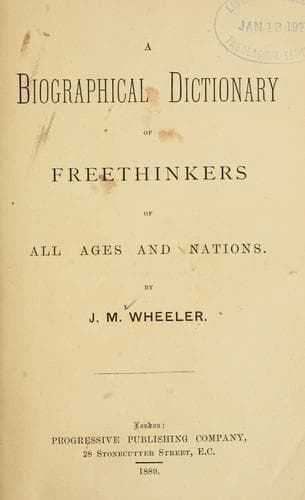
A Biographical Dictionary of Freethinkers of All Ages and NationsWheeler, J. M. (Joseph Mazzini)
Religion
A Biographical Dictionary of Freethinkers of All Ages and Nations
Wheeler, J. M. (Joseph Mazzini)
Free thought -- Biography
Boutteville (Marc Lucien), French writer, professor at the Lycée
Bonaparte; has made translations from Lessing and published an
able work on the Morality of the Church and Natural Morality, 1866,
for which the clergy turned him out of a professorship he held at
Sainte-Barbe.
Bovio (Giovanni), Professor of Political Economy in the University
of Naples and deputy to the Italian parliament; is an ardent
Freethinker. Both in his writings and in parliament Prof. Bovio
opposes the power of the Vatican and the reconciliation between
Church and State. He has constantly advocated liberty of conscience
and has promoted the institution of a Dante chair in the University
of Rome. He has written a work on The History of Law, a copy of which
he presented to the International Congress of Freethinkers, 1887.
Bowring (Sir John, K.B., LL D.), politician, linguist and writer,
b. Exeter, 17 Oct., 1792. In early life a pupil of Dr. Lant
Carpenter and later a disciple of Jeremy Bentham, whose principles
he maintained in the Westminster Review, of which he was editor,
1825. Arrested in France in 1822, after a fortnight's imprisonment
he was released without trial. He published Bentham's Deontology
(1834), and nine years after edited a complete collection of the
works of Bentham. Returned to Parliament in '35, and afterwards was
employed in important government missions. In '55 he visited Siam,
and two years later published an account of The Kingdom and People
of Siam. He translated Goethe, Schiller, Heine, and the poems of
many countries; was an active member of the British Association and
of the Social Science Association, and did much to promote rational
views on the Sunday question. Died 23 Nov. 1872.
Boyle (Humphrey), one of the men who left Leeds for the purpose of
serving in R. Carlile's shop when the right of free publication was
attacked in 1821. Boyle gave no name, and was indicted and tried as
"a man with name unknown" for publishing a blasphemous and seditious
libel. In his defence he ably asserted his right to hold and publish
his opinions. He read portions of the Bible in court to prove he was
justified in calling it obscene. Upon being sentenced, 27 May, 1822,
to eighteen months' imprisonment and to find sureties for five years,
he remarked "I have a mind, my lord, that can bear such a sentence
with fortitude."
Public-domain text, read in full here on John Shaqi.
Reviews
Reviews
No reviews yet
Be the first to share your thoughts on this work.
Join the Discussion
Join the discussion
Sign in to leave a comment or review.
Sign InorCreate an account