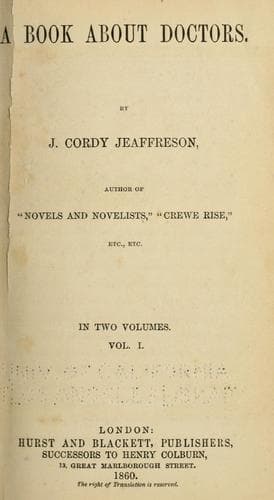
Medicine -- Anecdotes; Physicians -- Great Britain
The fortunes which pretenders to the healing art have amassed would
justify a belief that empiricism, under favourable circumstances, is
the best trade to be found in the entire list of industrial
occupations. Quacks have in all ages found staunch supporters amongst
the powerful and affluent. Dr. Myersbach, whom Lettsom endeavoured to
drive back into obscurity, continued, long after the publication of
the "Observations," to make a large income out of the credulity of the
fashionable classes of English society. Without learning of any kind,
this man raised himself to opulence. His degree was bought at Erfurth
for a few shillings, just before that university raised the prices of
its academical distinctions, in consequence of the pleasant raillery
of a young Englishman, who paid the fees for a Doctor's diploma, and
had it duly recorded in the Collegiate archives as having been
presented to Anglicus Ponto; Ponto being no other than his mastiff
dog. With such a degree Myersbach set up for a philosopher. Patients
crowded to his consulting-room, and those who were unable to come sent
their servants with descriptions of their cases. But his success was
less than that of the inventor of Ailhaud's powders, which ran their
devastating course through every country in Europe, sending to the
silence of the grave almost as many thousands as were destroyed in all
Napoleon's campaigns. Tissot, in his "Avis au Peuple," published in
1803, attacked Ailhaud with characteristic vehemence, and put an end
to his destructive power; but ere this took place the charlatan had
mounted on his slaughtered myriads to the possession of three
baronies, and was figuring in European courts as the Baron de
Castelet.
The tricks which these practitioners have had recourse to for the
attainment of their ends are various. Dr. Katterfelto, who rose into
eminence upon the evil wind that brought the influenza to England in
the year 1782, always travelled about the country in a large caravan,
containing a number of black cats. This gentleman's triumphant
campaign was brought to a disastrous termination by the mayor of
Shrewsbury, who gave him a taste of the sharp discipline provided at
that time by the law for rogues and vagabonds.--"The Wise Man of
Liverpool," whose destiny it was to gull the canny inhabitants of the
North of England, used to traverse the country in a chariot drawn by
six horses, attended by a perfect army of outriders in brilliant
liveries, and affecting all the pomp of a prince of the royal blood.
Public-domain text, read in full here on John Shaqi.
Reviews
Reviews
No reviews yet
Be the first to share your thoughts on this work.
Join the Discussion
Join the discussion
Sign in to leave a comment or review.
Sign InorCreate an account