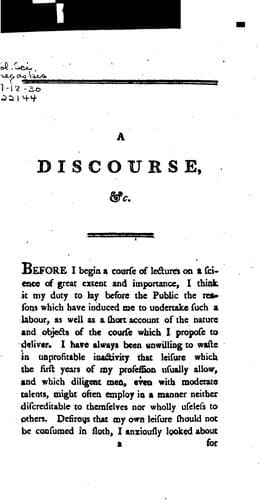
A Discourse on the Study of the Law of Nature and NationsMackintosh, James, Sir
Philosophy
A Discourse on the Study of the Law of Nature and Nations
Mackintosh, James, Sir
International law; Natural law
---- Mulier conjuncta viro concessit in unum,
castaque privatae veneris connubia laeta
cognita sunt, prolemque ex se videre coortam:
TUM GENUS HUMANUM PRIMUM MOLLESCERE COEPIT.
---- puerisque parentum
Blanditiis facile ingenium fregere superbum.
_Tunc et amicitiam coeperunt jungere_ habentes
Finitima inter se, nec laedere nec violare.
Et pueros commendarunt muliebreque seclum
Vocibus et gestu cum balbe significarent
IMBECILLORUM ESSE AEQUUM MISERIER OMNIUM.
_Lucret._ lib. v. 1. 1010-22.
[21] The introduction to the first book of Aristotle's Politics is the
best demonstration of the necessity of political society to the
well-being, and indeed to the very being, of man, with which I am
acquainted. Having shewn the circumstances which render man necessarily
a social being, he justly concludes, "[Greek: Kai oti anthropos physei
politikon zoon.]"--_Arist. de Rep._ lib. i.
The same scheme of philosophy is admirably pursued in the short, but
invaluable fragment of the sixth book of Polybius, which describes the
history and revolutions of government.
[22] To the weight of these great names let me add the opinion of two
illustrious men of the present age, as both their opinions are combined
by one of them in the following passage: "He (Mr. Fox) always thought
any of the simple unbalanced governments bad; simple monarchy, simple
aristocracy, simple democracy; he held them all imperfect or vicious,
all were bad by themselves; the composition alone was good. These had
been always his principles, in which he agreed with his friend, Mr.
Burke."--_Mr. Fox on the Army Estimates_, 9th Feb. 1790.
In speaking of both these illustrious men, whose names I here join, as
they will be joined in fame by posterity, which will forget their
temporary differences in the recollection of their genius and their
friendship, I do not entertain the vain imagination that I can add to
their glory by any thing that I can say. But it is a gratification to me
to give utterance to my feelings; to express the profound veneration
with which I am filled for the memory of the one, and the warm affection
which I cherish for the other, whom no one ever heard in public without
admiration, or knew in private life without loving.
[23] _Privilege_, in Roman jurisprudence, means the _exemption_ of one
individual from the operation of a law. Political privileges, in the
sense in which I employ the terms, mean those rights of the subjects of
a free state, which are deemed so essential to the well-being of the
commonwealth, that they are _excepted_ from the ordinary discretion of
the magistrate, and guarded by the same fundamental laws which secure
his authority.
Public-domain text, read in full here on John Shaqi.
Reviews
Reviews
No reviews yet
Be the first to share your thoughts on this work.
Join the Discussion
Join the discussion
Sign in to leave a comment or review.
Sign InorCreate an account