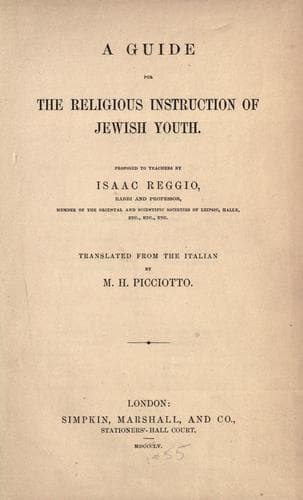
A Guide for the Religious Instruction of Jewish Youth — John Shaqi
A Guide for the Religious Instruction of Jewish YouthReggio, Isaac Samuel
Religion
A Guide for the Religious Instruction of Jewish Youth
Reggio, Isaac Samuel
Judaism -- Juvenile literature
LXXXIV. In promulgating the duties of man towards his fellow-men, the
holy scripture assumed sometimes the negative form, to forbid all that
which may cause injury to others; and sometimes the positive form,
enjoining the practice to be followed towards all. To the first class
belong the following prohibitions, viz., of nourishing hatred, rancour,
revenge; of calumniating, or in any way whatever damaging the
reputations of others; of assailing their honour or good fame; of
restraining or obstructing others in the exercise of their rights, or in
the use and enjoyment of their properties; of practising deceptions,
impositions, frauds, and all forms of insincerity, usury, extortions,
and violence; of laying obstructions in the way of the weak or helpless;
of giving false testimony; of speaking untruth; of reporting even truth,
when it may lead to discord and strife; of occasioning danger; of
offending decency and good manners; of causing scandal; of withholding
wages or remuneration due; of keeping in pledge the clothing or
implements of the poor; of using two weights and measures; of
associating with the wicked; of breaking a pledge-word; of violating or
assailing the conjugal happiness of others; of coveting anything that
belongs to others; and other similar prohibitions recorded in the sacred
code, which can be easily collected as pertaining to this class.
Moreover, it will not be unreasonable to complete this list by the
addition of a few more particular actions, which, though not
specifically mentioned, must yet be understood to be forbidden; for, as
it is a constant rule in biblical exegesis to deduce general theories
from single laws which appear to refer to particular cases, so must, by
analogy, be comprised in an enunciated forbidden action all others of a
similar nature, character, and tendency, as being understood in the
former.
Public-domain text, read in full here on John Shaqi.
Reviews
Reviews
No reviews yet
Be the first to share your thoughts on this work.
Join the Discussion
Join the discussion
Sign in to leave a comment or review.
Sign InorCreate an account