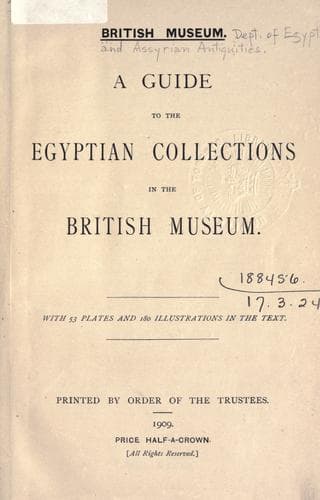
A guide to the Egyptian collections in the British MuseumBritish Museum. Department of Egyptian and Assyrian Antiquities
History
A guide to the Egyptian collections in the British Museum
British Museum. Department of Egyptian and Assyrian Antiquities
Egypt -- Antiquities
=8.= In all periods the burial of the dead was accompanied by the
presentation of series of offerings. Up to the end of the Vth dynasty
a comparatively small number of names of offerings was inscribed on
the walls of the tombs, and in the presentation of such offerings
consisted the ceremony of =Opening the Mouth= of the dead. Under the
VIth dynasty a new and enlarged list of offerings was drawn up, and a
series of formulas was added to it for recital by the priest as object
after object was presented to the mummy. In many of these formulas there
were plays of words upon the names of the offerings, each of which
was symbolical of some divine being, or object, or act. Several new
ceremonies connected with the purification and censing of the mummy, and
the use of instruments in “opening the mouth and eyes” of the mummy were
introduced at this time. To this List of Offerings, with its rubrics, the
name of =Liturgy of Funerary Offerings= may be given. Under the XVIIIth
dynasty a further development of the List of Offerings took place, and
new ceremonies were added, and the work was henceforth known as the =Book
of Opening the Mouth=. The visitor will see on the west wall of the
Second Egyptian Room a large coloured drawing in which the performance
of ceremonies connected with the opening of the mouth is represented.
One priest is supposed to be touching the mouth of the mummy with the
=Ur-ḥeka= instrument, and is holding other instruments; the other priest
is presenting vases of water. Behind them is the KHER ḤEB, or Lector, who
is pouring out water from a libation vase and burning incense. The object
of the Book of Opening the Mouth was: 1. To give the deceased a new
body in the Other World, and to make him to be divine. 2. To establish
communion between the living and the dead. In later days a statue of the
deceased took the place of his mummy in the ceremonies, and then the
chief object of the ceremonies, formulas, and offerings, was to provide a
dwelling place for the _Ka_ or “double” of the deceased, and to make his
soul to take up its abode in the statue. The Book of Opening the Mouth
was in general use from the Vth dynasty to the first or second century of
our era, that is, for a period of 4,000 years, and copies of it made in
the Roman Period are almost identical with those found in the Pyramids of
Ṣaḳḳârah of the VIth dynasty.
Public-domain text, read in full here on John Shaqi.
Reviews
Reviews
No reviews yet
Be the first to share your thoughts on this work.
Join the Discussion
Join the discussion
Sign in to leave a comment or review.
Sign InorCreate an account