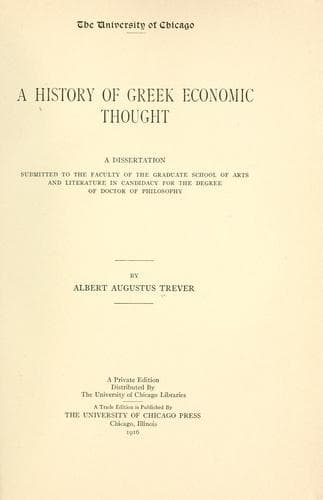
A History of Greek Economic ThoughtTrever, Albert Augustus
History
A History of Greek Economic Thought
Trever, Albert Augustus
Economics -- Greece -- History; Thesis (Ph. D.)
The common assertion that Plato has no regard for the artisan class,
then, is unwarranted.[274] The entire _Republic_ is built upon the
opposite principle, to prevent exploitation of the lower by the upper
classes; and his comparison of good and evil rulers to shepherd dogs and
wolves[275] is a precursor of the famous passages of Milton and Ruskin
on the same theme. All classes of citizens in the state are
brothers.[276] The rulers are saviors (σωτῆρας), allies, shepherds
(ποίμενες), nurses (τροφέας), paymasters, and friends.[277] This happy
unity (ὁμόνοια), or harmony (ξυμφωνία), of all classes is to Plato the
highest goal toward which the true statesman should strive,[278] and the
point of next highest importance to the communism of the guards is the
proper regulation of wealth and poverty for the artisans.[279] The mere
fact that he does not believe the artisans to be capable of political
independence by no means indicates that he is indifferent to their
social or economic welfare. It is to conserve this that he would put the
government into the hands of the most capable,[280] and, in any event,
the artisans are not to be held in subjection so much by external force
as by their own free self-restraint.[281] This, in itself, is sufficient
evidence that Plato intended to include the third class in his lower
scheme of education, a fact borne out also by other passages.[282]
It must be admitted that a somewhat different spirit pervades the
_Laws_, where he seems to have despaired of the lofty ideal of the
_Republic_. He relegates the working classes to non-citizenship. But
here, also, he is still anxious that they shall have the sort of
education that befits their station,[283] and that justice be done
them.[284] He also provides against the existence of beggary in the
state.[285] Whatever may be said of his aristocratic spirit, therefore,
he cannot be justly accused of the gross indifference of the early
nineteenth-century economy and of modern capitalism toward either masses
or public, in their concern for material wealth.[286]
COMMUNISTIC AND SOCIALISTIC IDEAS
The Greek theory of distribution was employed chiefly in the criticism
of the institution of private property, and in the suggestion of more or
less communistic systems to succeed it. This tendency, however, was not
like the modern either in motive or in general type. Modern socialism
aims to be scientific, and professes to build a scientific system on a
basis of economic laws. Greek socialism had no such aim. It did not lay
claim to any relation to economic law, but frankly presented itself for
what it was, a politico-moral sentiment. Other points of distinction
will be observed as we proceed, but this primary one must not be
overlooked, if either the spirit or the meaning of the Greek social
theory is to be understood.
Public-domain text, read in full here on John Shaqi.
Reviews
Reviews
No reviews yet
Be the first to share your thoughts on this work.
Join the Discussion
Join the discussion
Sign in to leave a comment or review.
Sign InorCreate an account