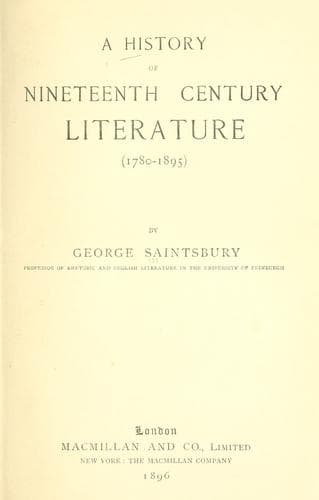
A History of Nineteenth Century Literature (1780-1895)Saintsbury, George
History
A History of Nineteenth Century Literature (1780-1895)
Saintsbury, George
English literature -- 19th century -- History and criticism
of her rights-of-women followers, is curiously free from bumptiousness
and the general qualities of the virago. She had but ill luck in life,
and perhaps showed no very good judgment in letters, but she had neither
bad brains nor bad blood; and the references to her, long after her
death, by such men as Southey, show the charm which she exercised.
With Godwin also is very commonly connected Thomas Holcroft (or, as Lamb
always preferred to spell the name, "_Ould_craft"), a curiosity of
literature and a rather typical figure of the time. Holcroft was born in
London in December 1745, quite in the lowest ranks, and himself rose
from being stable-boy at Newmarket, through the generally democratic
trade of shoemaking, to quasi-literary positions as schoolmaster and
clerk, and then to the dignity of actor. He was about thirty-five when
he first began regular authorship; and during the rest of his life he
wrote four novels, some score and a half of plays, and divers other
works, none of which is so good as his Autobiography, published after
his death by Hazlitt, and said to be in part that writer's work. It
would have been fortunate for Holcroft if he had confined himself to
literature; for some of his plays, notably _The Road to Ruin_, brought
him in positively large sums of money, and his novels were fairly
popular. But he was a violent democrat,--some indeed attributed to him
the origination of most of the startling things in Godwin's _Political
Justice_,--and in 1794 he was tried, though with no result, for high
treason, with Horne Tooke and others. This brought him into the society
of the young Jacobin school,--Coleridge, and the rest,--but was
disastrous to the success of his plays; and when he went abroad in 1799
he entered on an extraordinary business of buying old masters (which
were rubbish) and sending them to England, where they generally sold for
nothing. He returned, however, and died on 23rd March 1809.
Public-domain text, read in full here on John Shaqi.
Reviews
Reviews
No reviews yet
Be the first to share your thoughts on this work.
Join the Discussion
Join the discussion
Sign in to leave a comment or review.
Sign InorCreate an account