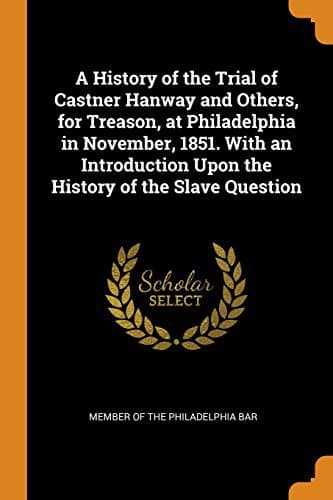
A History of the Trial of Castner Hanway and Others, for Treason, at Philadelphia in November, 1851: With an Introduction upon the History of the Slave QuestionMember of the Philadelphia bar
History
A History of the Trial of Castner Hanway and Others, for Treason, at Philadelphia in November, 1851: With an Introduction upon the History of the Slave Question
Member of the Philadelphia bar
Fugitive slaves -- Legal status, laws, etc. -- United States; Hanway, Castner, 1821-1893 -- Trials, litigation, etc.; Riots -- Pennsylvania -- Christiana; Trials (Treason) -- Pennsylvania -- Philadelphia; United States -- Fugitive slave law (1850)
On the next day, like bills were returned against S. Williams, J.
Hammond, H. Curtis, W. Williams, W. Thomas and N. Ferd.
The bill against Noah Buley was ignored.
On the following Monday, the 6th of October, the U. S. Circuit Court,
in which the prisoners were to be tried, held its session. The District
Attorney moved for a special venire to issue to the Marshal to summon
108 Jurors, 12 of whom were to be from Lancaster County, “to try the
charges against Elijah Lewis and 37 others who had been committed for
treason against the United States growing out of the murderous outrage
at Christiana.” He announced that he would move for the arraignment of
the prisoners on the following Thursday, and that the fourth Monday of
November had been fixed for the trials. Judge Grier said that such a
motion was strictly proper, and he directed the Marshal “to summon men
of the highest respectability of character, for intelligence, integrity
and conscientiousness, in the community, and to inform them that their
attendance will be enforced by the Court, and that no excuse but
sickness would be received for non-attendance.”
The arraignment did not take place the next Thursday, for reasons best
known to the District Attorney. No further public proceedings were had
until the trial. In the mean time the Traitors were made as comfortable
by the attentions of their friends as the rules of the prison
permitted. Though the building was erected at an enormous expense, it
is badly ventilated and miserably heated. Yet the rules did not permit
any of the prisoners to have fire in their cells, which at that season
of the year was absolutely essential to their comfort. Some of them,
predisposed to pulmonary complaints, suffered severely on account
of this privation. Before the termination of the trial the Court
ordered the Marshal to provide more suitable quarters for two of them,
representations having been made by their counsel that this precaution
was necessary to preserve their health and probably their lives.
On Sunday morning, Nov. 9, about 4 o’clock, two of the witnesses for
the prosecution, who had been detained in the Debtors apartment of the
Moyamensing Prison, made their escape, by means of the shutters of
their cells and their blankets. A white man who was under confinement
on another charge went with them.
Public-domain text, read in full here on John Shaqi.
Reviews
Reviews
No reviews yet
Be the first to share your thoughts on this work.
Join the Discussion
Join the discussion
Sign in to leave a comment or review.
Sign InorCreate an account