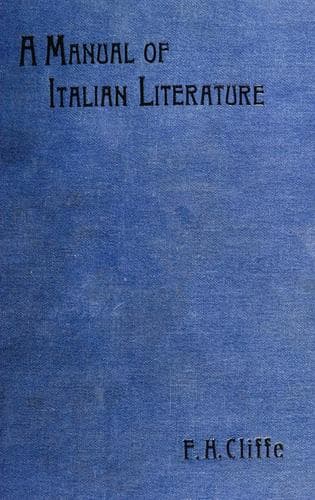
A manual of Italian literatureCliffe, Francis Henry
History
A manual of Italian literature
Cliffe, Francis Henry
Italian literature -- History and criticism
It has always been the policy of despots to supply their subjects with
plenty of amusements. Accordingly we find in the Seventeenth Century
records of gorgeous pageants and brilliant theatrical entertainments,
and the already waning wealth of the nation was further exhausted by
reckless prodigality of governments and individuals. Italian Opera
took its origin early in the Century, and RINUCCINI was the first
Librettist. The theatre more and more engaged the attention of
writers, but nothing remarkable was produced, with the exception,
perhaps, of the tragedies of CARDINAL DELFINO, Patriarch of Aquilea,
which present here and there touches worthy of a fine poet. The
death-scene of his _Cleopatra_ bears a striking resemblance to the
corresponding scene in _Anthony and Cleopatra,_ although he doubtless
never so much as heard of Shakespeare's name.
BATTISTA GUARINI, who died in 1612, was pre-eminent, by reason of his
_Pastor Fido,_ among writers of Pastoral Plays; but these insipid and
unreal creations have no attraction for modern readers. The _Pastor
Fido_ is a work of much skill and ingenuity; but it is tainted with
that fondness for quibbles and conceits which disfigures so much of the
literature of the Seventeenth Century, not only in Italy, but also in
other countries. If Italy had her Marino, Spain had her Gongora, France
her Benserade, and England her Lyly, Donne, and Cowley. It is curious
to remark how a literary fashion spreads from one country to another,
and in that age of scanty travel and difficult communication, it is
doubly curious. Thus, in the early part of the Nineteenth Century,
Byronism became a universal epidemic.
The love of far-fetched conceits originated in the latter half of the
Sixteenth Century. We see much of it in Shakespeare's early comedies,
and the traces of it in Tasso gave ground to Boileau one hundred years
later to sneer at those who preferred "the tinsel of Tasso to the gold
of Virgil."
"A Racan, à Malherbe, préférer Théophile,
Et le clinquant du Tasse à tout l'or de Virgile."
It is, however, unjust to blame Tasso for an inordinate profusion of
conceits. He presents some, it is true, but they are almost always
ingenious and imaginative, and not so far-fetched as to be unnatural.
Public-domain text, read in full here on John Shaqi.
Reviews
Reviews
No reviews yet
Be the first to share your thoughts on this work.
Join the Discussion
Join the discussion
Sign in to leave a comment or review.
Sign InorCreate an account