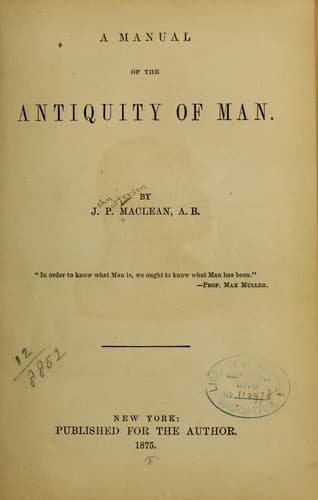
A Manual of the Antiquity of ManMacLean, J. P. (John Patterson)
History
A Manual of the Antiquity of Man
MacLean, J. P. (John Patterson)
Human beings -- Origin
The impulse given by the rigors of glacial times acted beneficially
throughout this period. The rude axes and flints were retained, but
improvements were made in utilizing the bones and horns of animals. Out
of these, bodkins, fish-hooks, and arrow-heads were made. The teeth of
wild animals were perforated, and, along with corals and shells, were
used for ornaments. The caverns, used as dwelling-places, being
destitute of water, this necessary of life was supplied and carried
thither in rude vessels made of clay and dried in the sun. The arrows,
flint knives, and axes were used for killing and skinning the animals,
splitting the bones containing the marrow, shaping the bone implements,
felling trees, and stripping the bark, which was used at times for
clothing, after having been softened by beating. He commenced the art of
engraving, as is witnessed by a sketch of the great cave-bear wrought on
a curious stone found in the cave of Massat (Ariége), the bird's head
formed from the bone of a cave-bear, at Aurignac, and other examples.
The lower jaw-bones of the cave-bear and cave-lion, in the shape of
hoes, used for digging roots, were found in the caves of Lherm and in
Bouicheta. He made hearth-stones, and on them cooked his food. That he
paid honors to the dead, and sheltered them from the ravages of beasts
of prey, at present, must remain an open question. If he did, it might
seem to imply that he had a religious nature. But when it is considered
that he was very low in the scale of existence, it may be inferred that
this was done, if done at all, to propitiate an evil genius. Or it may
be a faint idea of a ghost state and that these feasts were made to
dissuade the ghost from molesting him. That they had a conception of a
Supreme Ruler, or a number of gods who ruled for the good of man, would
be too preposterous to believe.
Professor Denton has given a description of primeval time which, by a
little change, would represent inter-glacial times: "The seasons are
fairly established; and spring follows winter, and fall summer, as now;
though the summer is longer and warmer than we are accustomed to see in
those countries at the present time, and the winters colder. The country
is covered with dense forests, through which ramble mighty elephants in
herds, with immense curved tusks, coats of long, shaggy hair, and
flowing manes.... Shuffling along comes the great cave-bear from his
rocky den--as large as a horse: fierce, shaggy, conscious of his
strength, he fears no adversary. Crouched by a bubbling spring lies the
cave-tiger (_Felis spelæa_); and, as the wild cattle come down to drink,
he leaps upon the back of one, and a terrible combat ensues. It is as
large as an elephant, and its horns of enormous size; and even
cave-tigers could not always master such cattle as they.
Public-domain text, read in full here on John Shaqi.
Reviews
Reviews
No reviews yet
Be the first to share your thoughts on this work.
Join the Discussion
Join the discussion
Sign in to leave a comment or review.
Sign InorCreate an account