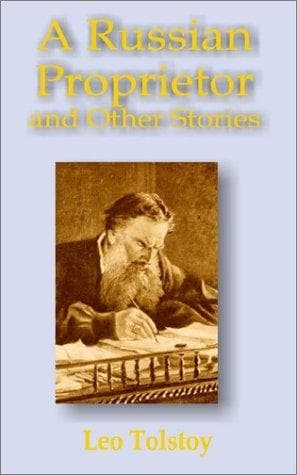
A Russian Proprietor, and Other StoriesTolstoy, Leo, graf
General
A Russian Proprietor, and Other Stories
Tolstoy, Leo, graf
Russia -- Social life and customs -- Fiction; Tolstoy, Leo, graf, 1828-1910 -- Translations into English
He, however, expressed his gratitude with deep feeling, as it seemed to me,
for his entertainment. His teary eyes grew still more humid and brilliant,
and he made use of a most strange and complicated phrase of gratitude. But
still very pleasant to me was the sentence in which he said that if
everybody treated artists as I had been doing, it would be very good, and
ended by wishing me all manner of happiness. We went out into the hall
together. There stood the servants, and my enemy the porter apparently
airing his grievances against me before them. All of them, I thought,
looked at me as though I were a man who had lost his wits. I treated the
little man exactly like an equal, before all that audience of servants; and
then, with all the respect that I was able to express in my behavior, I
took off my hat, and pressed his hand with its dry and hardened fingers.
The servants made believe not pay the slightest attention to me. One of
them only indulged in a sarcastic laugh.
As soon as the minstrel had bowed himself out, and disappeared in the
darkness, I went up-stairs to my room, intending to sleep off all these
impressions and the foolish childish anger which had come upon me so
unexpectedly. But finding that I was too much excited to sleep, I once more
went down into the street with the intention of walking until I should have
recovered my equanimity, and, I must confess, with the secret hope that I
might accidentally come across the porter or the waiter or the Englishman,
and show them all their rudeness, and, most of all, their unfairness. But
beyond the porter, who when he saw me turned his back, I met no one; and I
began to promenade in absolute solitude along the quay.
"This is an example of the strange fate of poetry," said I to myself,
having grown a little calmer. "All love it, all are in search of it; it is
the only thing in life that men love and seek, and yet no one recognizes
its power, no one prizes this best treasure of the world, and those who
give it to men are not rewarded. Ask any one you please, ask all these
guests of the Schweitzerhof, what is the most precious treasure in the
world, and all, or ninety-nine out of a hundred, putting on a sardonic
expression, will say that the best thing in the world is money.
"'Maybe, though, this does not please you, or coincide with your elevated
ideas,' it will be urged, 'but what is to be done if human life is so
constituted that money alone is capable of giving a man happiness? I cannot
force my mind not to see the world as it is,' it will be added, 'that is,
to see the truth.'
Public-domain text, read in full here on John Shaqi.
Reviews
Reviews
No reviews yet
Be the first to share your thoughts on this work.
Join the Discussion
Join the discussion
Sign in to leave a comment or review.
Sign InorCreate an account