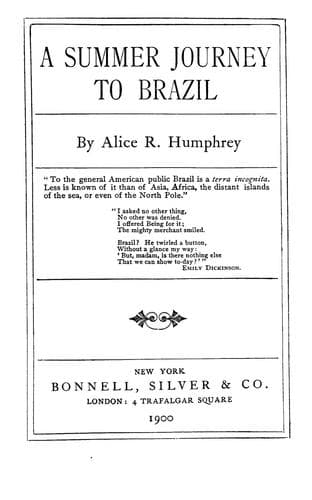
Brazil -- Description and travel; São Paulo (Brazil : State)
What has impaired the influence of the Church in Brazil has been the
corrupt and scandalous life of many of the clergy. This is not a wanton
Protestant charge. It is the sorrowful admission of faithful Catholics
themselves. The evil has been one of long standing. When Dom Pedro
II. was in his infancy, Antonio Diogo Feijo was Regent of the Empire.
He proposed as a good Catholic a measure for sanctioning the marriage
of the clergy, and compelling the Papal authorities under menace of
disestablishment to allow its enforcement. When the measure failed,
he wrote a book entitled _Celibao Clerical_ or _Clerical Celibacy_ in
defense of his position, with many detailed statements of fact. The
book was burned by order of the ecclesiastical authorities, but a copy
of it was found in a village of San Paulo not long ago, and an edition
of 5,000 copies was immediately reprinted. The immorality which this
devout Catholic Regent denounced in his day still defiles the influence
of the Church in Brazil. Some of the most active politicians here are
known to be the sons of priests. Celibacy is too often only a cloak for
immorality here. Good Catholics frankly tell you that this is one of
the open scandals of their Church.
This is a time when there is real educational work to be done in
Brazil. A nation is to be trained for self-government and citizenship.
Old things have passed away. New social and political conditions are to
be created. The Church should have a great part in this work of making
a nation. It should be breaking the bonds of superstition, ignorance
and medievalism. It should be teaching men and women by the example
of its own clergy to lead pure and incorrupt lives. It should be
leavening the whole lump of Brazilian republicanism. If the Church were
disestablished and the clergy purified and reformed, it would be one
of the grandest and most useful results of the revolution. For, in the
long run, no nation in its political life and aspirations can get above
the level of the religion which it believes or affects to despise.
1864 AND 1900.
“There is much that is discouraging in the aspect of Brazil, even for
those who hope and believe as I do that she has before her an honorable
and powerful career.
“There is much also that is very cheering, that leads me to believe
that her life as a nation will not belie her great gifts as a country.
Should her moral and intellectual endowments grow into harmony with
her wonderful natural beauty and wealth the world will not have seen a
fairer land.
“Every friend of Brazil must wish to see its present priesthood
replaced by a more vigorous, intelligent, and laborious clergy.”--PROF.
LOUIS AGASSIZ, 1864.
Public-domain text, read in full here on John Shaqi.
Reviews
Reviews
No reviews yet
Be the first to share your thoughts on this work.
Join the Discussion
Join the discussion
Sign in to leave a comment or review.
Sign InorCreate an account