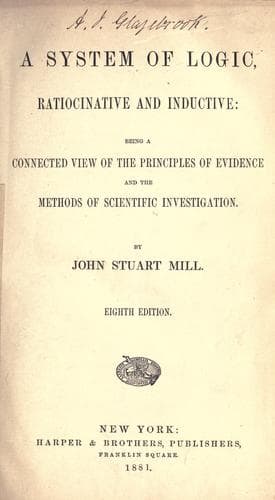
A System of Logic, Ratiocinative and InductiveMill, John Stuart
PhilosophyPhilosophy
A System of Logic, Ratiocinative and Inductive
Mill, John Stuart
Knowledge, Theory of; Logic; Science -- Methodology
All likeness and unlikeness of which we have any cognizance, resolve
themselves into likeness and unlikeness between states of our own, or some
other, mind. When we say that one body is like another, (since we know
nothing of bodies but the sensations which they excite,) we mean really
that there is a resemblance between the sensations excited by the two
bodies, or between some portions at least of those sensations. If we say
that two attributes are like one another (since we know nothing of
attributes except the sensations or states of feeling on which they are
grounded), we mean really that those sensations, or states of feeling,
resemble each other. We may also say that two relations are alike. The
fact of resemblance between relations is sometimes called _analogy_,
forming one of the numerous meanings of that word. The relation in which
Priam stood to Hector, namely, that of father and son, resembles the
relation in which Philip stood to Alexander; resembles it so closely that
they are called the same relation. The relation in which Cromwell stood to
England resembles the relation in which Napoleon stood to France, though
not so closely as to be called the same relation. The meaning in both
these instances must be, that a resemblance existed between the facts
which constituted the _fundamentum relationis_.
This resemblance may exist in all conceivable gradations, from perfect
undistinguishableness to something extremely slight. When we say, that a
thought suggested to the mind of a person of genius is like a seed cast
into the ground, because the former produces a multitude of other
thoughts, and the latter a multitude of other seeds, this is saying that
between the relation of an inventive mind to a thought contained in it,
and the relation of a fertile soil to a seed contained in it, there exists
a resemblance: the real resemblance being in the two _fundamenta
relationis_, in each of which there occurs a germ, producing by its
development a multitude of other things similar to itself. And as,
whenever two objects are jointly concerned in a phenomenon, this
constitutes a relation between those objects, so, if we suppose a second
pair of objects concerned in a second phenomenon, the slightest
resemblance between the two phenomena is sufficient to admit of its being
said that the two relations resemble; provided, of course, the points of
resemblance are found in those portions of the two phenomena respectively
which are connoted by the relative names.
Public-domain text, read in full here on John Shaqi.
Reviews
Reviews
No reviews yet
Be the first to share your thoughts on this work.
Join the Discussion
Join the discussion
Sign in to leave a comment or review.
Sign InorCreate an account