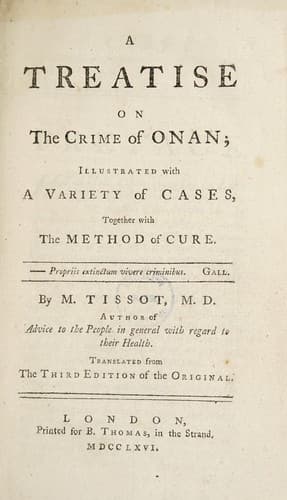
A Treatise on the Crime of Onan: Illustrated with a Variety of Cases, Together with the Method of CureTissot, S. A. D. (Samuel Auguste David)
Science
A Treatise on the Crime of Onan: Illustrated with a Variety of Cases, Together with the Method of Cure
Tissot, S. A. D. (Samuel Auguste David)
Masturbation -- Early works to 1800; Sexual ethics -- Early works to 1800
What I have above said of fruits, need not, however, hinder, where the
stomach still preserves something of its strength, one’s indulging one’s
self, now and then, with a small quantity of the best chosen for the
sort, and for ripeness; the most watery are those which are the least
proper.
Eggs are an aliment of the animal kind, and an aliment extremely useful;
they strengthen greatly, and are easy of digestion, provided that they
have but little or even no preparation by fire, for if the white is
once hardened it does not dissolve again; it becomes heavy, indigest,
and unnutritious: it might then be the aliment of those who digest too
quickly, and not of those who have rather no digestion. The best way of
eating them, is just as they are new laid from the fowl, without any
preparation, or in the shell, after only three or four dips in boiling
water, or stirred into warm, and not boiling broth.
Conclusively; there remains to mention the aliment from milk; which
unites all the qualities that can be desired, without having any of the
inconveniences that are to be dreaded. It is the most simple, the most
easily assimilable, and the quickest restorative: all prepared as it is
by nature, it needs no risk of spoiling it by an artificial preparation:
like the broth of flesh meats it nourishes, but is not susceptible of
putridity; it prevents thirst, it supplies the place of meat and drink;
it keeps up all the secretions; it disposes for tranquil sleep; in short,
it fulfils all the indications that present themselves in this case. M.
LEWIS attests its having produced the best effects[106]. Why then is not
it always employed, always substituted to the other aliments? Answer. For
a reason which is peculiar to it, which unnaturalises its effect, and
which makes it sometimes produce a very different one, from that which
might be hoped from it, or reasonably expected.
Public-domain text, read in full here on John Shaqi.
Reviews
Reviews
No reviews yet
Be the first to share your thoughts on this work.
Join the Discussion
Join the discussion
Sign in to leave a comment or review.
Sign InorCreate an account