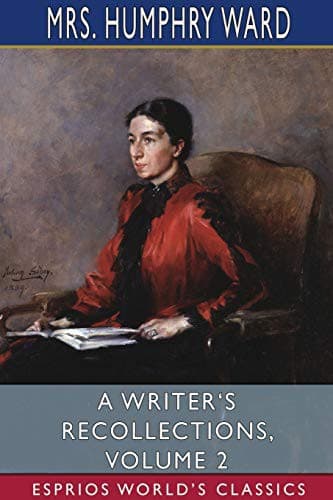
A Writer's Recollections — Volume 2Ward, Humphry, Mrs.
General
A Writer's Recollections — Volume 2
Ward, Humphry, Mrs.
Novelists, English -- 19th century -- Biography; Novelists, English -- 20th century -- Biography; Ward, Humphry, Mrs., 1851-1920
Count Pasolini's father was also one of Pio Nono's Liberal Ministers,
and the family, at the time, at any rate, of which I am speaking,
combined Liberalism and sympathies for England with an enlightened and
ardent Catholicism. I first made friends with Contessa Maria when we
found her, on a cold February day, receiving in an apartment in the
Piazza dei Santi Apostoli--rather gloomy rooms, to which her dark head
and eyes, her extraordinary expressiveness and grace, and the vivacity
of her talk, seemed to lend a positive brilliance and charm. In her I
first came to know, with some intimacy, a cultivated Italian woman, and
to realize what a strong kindred exists between the English and the
Italian educated mind. Especially, I think, in the case of the educated
_women_ of both nations. I have often felt, in talking to an Italian
woman friend, a similarity of standards, of traditions and instincts,
which would take some explaining, if one came to think it out.
Especially on the practical side of life, the side of what one may call
the minor morals and judgments, which are often more important to
friendship and understanding than the greater matters of the law. How an
Italian lady manages her servants and brings up her children; her
general attitude toward marriage, politics, books, social or economic
questions--in all these fields she is, in some mysterious way, much
nearer to the Englishwoman than the Frenchwoman is. Of course, these
remarks do not apply to the small circle of "black" families in Italy,
particularly in Rome, who still hold aloof from the Italian kingdom and
its institutions. But the Liberal Catholic, man or woman, who is both
patriotically Italian and sincerely religious, will discuss anything or
anybody in heaven or earth, and just as tolerantly as would Lord Acton
himself. They are cosmopolitans, and yet deep rooted in the Italian
soil. Contessa Maria, for instance, was in 1889 still near the
beginnings of what was to prove for twenty-five years the most
interesting _salon_ in Rome. Everybody met there. Grandees of all
nations, ambassadors, ecclesiastics, men of literature, science,
archeology, art, politicians, and diplomats--Contessa Pasolini was equal
to them all, and her talk, rapid, fearless, picturesque, full of
knowledge, yet without a hint of pedantry, gave a note of unity to a
scene that could hardly have been more varied or, in less skilful hands,
more full of jarring possibilities. But later on, when I knew her
better, I saw her also with peasant folk, with the country people of the
Campagna and the Alban hills. And here one realized the same ease, the
same sympathy, the same instinctive and unerring _success_, as one might
watch with delight on one of her "evenings" in the Palazzo Sciarra. When
she was talking to a peasant woman on the Alban ridge, something broad
and big and primitive seemed to come out in her, something of the _Magna
parens_, the Saturnian land; but something, too, that our Englishwomen,
Public-domain text, read in full here on John Shaqi.
Reviews
Reviews
No reviews yet
Be the first to share your thoughts on this work.
Join the Discussion
Join the discussion
Sign in to leave a comment or review.
Sign InorCreate an account