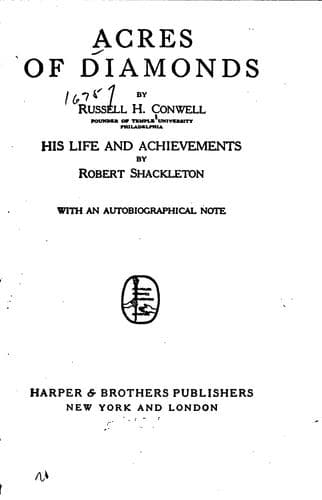
This stirring manifesto shows how to discover everything you need to succeed— where you least expect it.So begins one of the most famous speeches of the twentieth century, a talk that educator and minister Russell H. Conwell delivered before literally thousands of audiences before his death in 1925. In its printed version Acres of Diamonds reached millions of readers around the world. Conwell's great manifesto imparts one extraordinary lesson: All the wealth you could ever dream of, search for, or yearn after—in whatever form you wish for—exists right beneath your own feet. It is a message of determination, unconventional thinking, and positive living that came to influence a generation of motivational literature.The Success Classics edition of Acres of Diamonds also features two rare bonus works: Praying for Money and The Story of "Acres of Diamonds" by journalist Robert Shackleton.
“And it was all through our jealousy of his success,” said the minister,
vehemently. “He came to this city a stranger, and he won instant
popularity, and we couldn’t stand it, and so we pounced upon things that
he did that were altogether unimportant. The rest of us were so jealous
of his winning throngs that we couldn’t see the good in him. And it
hurt Dr. Conwell so much that for ten years he did not come to our
conferences. But all this was changed long ago. Now no minister is so
welcomed as he is, and I don’t believe that there ever has been a single
time since he started coming again that he hasn’t been asked to say
something to us. We got over our jealousy long ago and we all love him.”
Nor is it only that the clergymen of his own denomination admire him,
for not long ago, such having been Dr. Conwell’s triumph in the city of
his adoption, the rector of the most powerful and aristocratic church in
Philadelphia voluntarily paid lofty tribute to his aims and ability, his
work and his personal worth. “He is an inspiration to his brothers in
the ministry of Jesus Christ,” so this Episcopalian rector wrote. “He is
a friend to all that is good, a foe to all that is evil, a strength to
the weak, a comforter to the sorrowing, a man of God. These words come
from the heart of one who loves, honors, and reverences him for his
character and his deeds.”
Dr. Conwell did some beautiful and unusual things in his church,
instituted some beautiful and unusual customs, and one can see
how narrow and hasty criticisms charged him, long ago, with
sensationalism--charges long since forgotten except through the hurt
still felt by Dr. Conwell himself. “They used to charge me with making a
circus of the church--as if it were possible for me to make a circus of
the church!” And his tone was one of grieved amazement after all these
years.
But he was original and he was popular, and therefore there were
misunderstanding and jealousy. His Easter services, for example, years
ago, became widely talked of and eagerly anticipated because each sermon
would be wrought around some fine symbol; and he would hold in his hand,
in the pulpit, the blue robin’s egg, or the white dove, or the stem
of lilies, or whatever he had chosen as the particular symbol for the
particular sermon, and that symbol would give him the central thought
for his discourse, accented as it would be by the actual symbol itself
in view of the congregation. The cross lighted by electricity, to
shine down over the baptismal pool, the little stream of water cascading
gently down the steps of the pool during the baptismal rite, the roses
floating in the pool and his gift of one of them to each of the baptized
as he or she left the water--all such things did seem, long ago, so
unconventional. Yet his own people recognized the beauty and poetry of
them, and thousands of Bibles in Philadelphia have a baptismal rose from
Dr. Conwell pressed within the pages.
Public-domain text, read in full here on John Shaqi.
Reviews
Reviews
No reviews yet
Be the first to share your thoughts on this work.
Join the Discussion
Join the discussion
Sign in to leave a comment or review.
Sign InorCreate an account