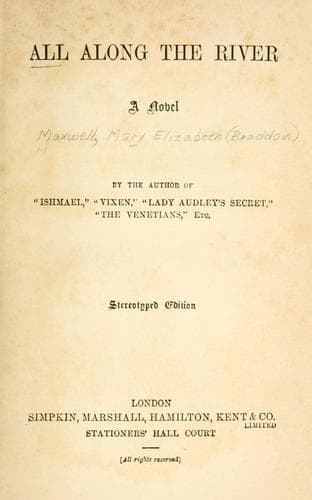
All along the River: A NovelBraddon, M. E. (Mary Elizabeth)
General
All along the River: A Novel
Braddon, M. E. (Mary Elizabeth)
English fiction -- 19th century
He gave her back her programme, with all the blanks filled in, and at
the bottom a word written, and triply underscored,
ἉΝΑΓΚΗ.
They had talked of Victor Hugo’s romantic story--that romance which
the great man so despised in after years that he was almost offended
if any one presumed to praise it in his hearing, although in the
half-century that has gone since Victor Hugo was a young man this story
of Notre Dame has been unsurpassed as an example of the romantic novel.
Lostwithiel had praised the book, and had talked of the monk Frollo,
and his fatal love--and that word Fatality, graven upon the wall of his
cell, and burnt into his soul.
Isola knew what those Greek letters meant. She dropped the little white
and gold programme as if it had been an adder. He went away to a duty
dance with a great lady of the district--a lady whose diamonds made a
light about her wherever she moved; and then he waltzed with Belinda
Crowther, to the admiration of the young lady’s mother, and of two or
three other matrons on the divan by the door. Were they not a splendid
couple, she so brilliantly fair, he dark and pale, bronzed slightly
with exposure to the sun in warmer climates than this--not positively
handsome, but with such an interesting countenance. So, and so, and so
prosed the matrons, until various middle-aged cavaliers came to invite
them to the tea-room, where there was the usual drawback in the shape
of a frightful draught from open windows, which the dancers, coming in
flushed and heated, voted delicious.
“This will be a good night’s work for me,” said Dr. Baynham,
cheerfully, although he considered it his duty to warn his patients of
their danger.
Conscience thus satisfied, he could look on complacently as they eat
ices, and selected cool corners of the refreshment-room to flirt in.
“Next to a juvenile party, I don’t know anything better--from a
professional point of view--than a public ball,” he said. “Your canvas
corridors, decorated with flowers and bunting, are a fortune to a
family practitioner.”
Isola danced every dance. She hardly knew who her partners were. She
had only a sense of floating in a vortex of light and colour, to some
swinging melody. Everything was dream-like--but not horrible, as in
her dream by the fireside at home. This was a happy dream, as of a
creature with wings, who knew not of care in the present or a soul to
be saved in the future. And then came her waltz with Lostwithiel, and
that strong arm was round her, bearing her up as a flower is borne upon
a rushing tide, so that she had no consciousness of movement on her own
part, only of floating, floating, floating, to that languid three-time
melody.
It was the last popular waltz they were playing--a waltz that had been
last summer’s delight in the arid gardens of South Kensington--“Il n’y
a que toi;” a waltz with a chorus which the band trolled out merrily,
at intervals, in the French of Stratford atte Bow.
Public-domain text, read in full here on John Shaqi.
Reviews
Reviews
No reviews yet
Be the first to share your thoughts on this work.
Join the Discussion
Join the discussion
Sign in to leave a comment or review.
Sign InorCreate an account