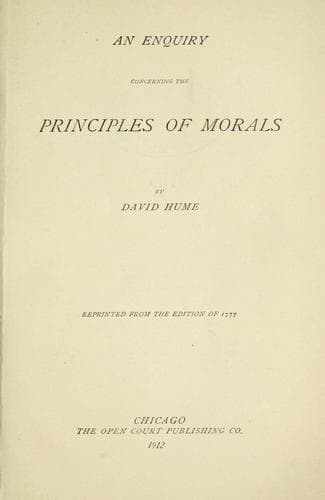
An Enquiry Concerning the Principles of MoralsHume, David
PhilosophyPhilosophy
An Enquiry Concerning the Principles of Morals
Hume, David
Conduct of life; Ethics
It appears also, that, in our general approbation of characters and
manners, the useful tendency of the social virtues moves us not by any
regards to self-interest, but has an influence much more universal
and extensive. It appears that a tendency to public good, and to the
promoting of peace, harmony, and order in society, does always, by
affecting the benevolent principles of our frame, engage us on the side
of the social virtues. And it appears, as an additional confirmation,
that these principles of humanity and sympathy enter so deeply into all
our sentiments, and have so powerful an influence, as may enable them
to excite the strongest censure and applause. The present theory is the
simple result of all these inferences, each of which seems founded on
uniform experience and observation.
Were it doubtful, whether there were any such principle in our nature
as humanity or a concern for others, yet when we see, in numberless
instances, that whatever has a tendency to promote the interests of
society, is so highly approved of, we ought thence to learn the force of
the benevolent principle; since it is impossible for anything to please
as means to an end, where the end is totally indifferent. On the other
hand, were it doubtful, whether there were, implanted in our nature, any
general principle of moral blame and approbation, yet when we see, in
numberless instances, the influence of humanity, we ought thence to
conclude, that it is impossible, but that everything which promotes the
interest of society must communicate pleasure, and what is pernicious
give uneasiness. But when these different reflections and observations
concur in establishing the same conclusion, must they not bestow an
undisputed evidence upon it?
It is however hoped, that the progress of this argument will bring a
farther confirmation of the present theory, by showing the rise of other
sentiments of esteem and regard from the same or like principles.
SECTION VI. OF QUALITIES USEFUL TO OURSELVES.
PART I.
IT seems evident, that where a quality or habit is subjected to our
examination, if it appear in any respect prejudicial to the person
possessed of it, or such as incapacitates him for business and action,
it is instantly blamed, and ranked among his faults and imperfections.
Indolence, negligence, want of order and method, obstinacy, fickleness,
rashness, credulity; these qualities were never esteemed by any one
indifferent to a character; much less, extolled as accomplishments or
virtues. The prejudice, resulting from them, immediately strikes our
eye, and gives us the sentiment of pain and disapprobation.
Public-domain text, read in full here on John Shaqi.
Reviews
Reviews
No reviews yet
Be the first to share your thoughts on this work.
Join the Discussion
Join the discussion
Sign in to leave a comment or review.
Sign InorCreate an account