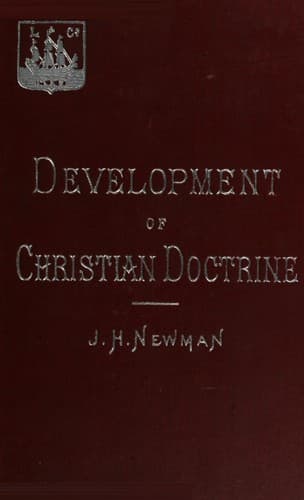
An Essay on the Development of Christian DoctrineNewman, John Henry
Religion
An Essay on the Development of Christian Doctrine
Newman, John Henry
Catholic Church -- Doctrines; Dogma, Development of
1. If Christianity is a fact, and impresses an idea of itself on our
minds and is a subject-matter of exercises of the reason, that idea will
in course of time expand into a multitude of ideas, and aspects of
ideas, connected and harmonious with one another, and in themselves
determinate and immutable, as is the objective fact itself which is thus
represented. It is a characteristic of our minds, that they cannot take
an object in, which is submitted to them simply and integrally. We
conceive by means of definition or description; whole objects do not
create in the intellect whole ideas, but are, to use a mathematical
phrase, thrown into series, into a number of statements, strengthening,
interpreting, correcting each other, and with more or less exactness
approximating, as they accumulate, to a perfect image. There is no other
way of learning or of teaching. We cannot teach except by aspects or
views, which are not identical with the thing itself which we are
teaching. Two persons may each convey the same truth to a third, yet by
methods and through representations altogether different. The same
person will treat the same argument differently in an essay or speech,
according to the accident of the day of writing, or of the audience, yet
it will be substantially the same.
And the more claim an idea has to be considered living, the more various
will be its aspects; and the more social and political is its nature,
the more complicated and subtle will be its issues, and the longer and
more eventful will be its course. And in the number of these special
ideas, which from their very depth and richness cannot be fully
understood at once, but are more and more clearly expressed and taught
the longer they last,--having aspects many and bearings many, mutually
connected and growing one out of another, and all parts of a whole, with
a sympathy and correspondence keeping pace with the ever-changing
necessities of the world, multiform, prolific, and ever
resourceful,--among these great doctrines surely we Christians shall not
refuse a foremost place to Christianity. Such previously to the
determination of the fact, must be our anticipation concerning it from a
contemplation of its initial achievements.
2.
It may be objected that its inspired documents at once determine the
limits of its mission without further trouble; but ideas are in the
writer and reader of the revelation, not the inspired text itself: and
the question is whether those ideas which the letter conveys from writer
to reader, reach the reader at once in their completeness and accuracy
on his first perception of them, or whether they open out in his
intellect and grow to perfection in the course of time. Nor could it
surely be maintained without extravagance that the letter of the New
Testament, or of any assignable number of books, comprises a delineation
of all possible forms which a divine message will assume when submitted
to a multitude of minds.
Public-domain text, read in full here on John Shaqi.
Reviews
Reviews
No reviews yet
Be the first to share your thoughts on this work.
Join the Discussion
Join the discussion
Sign in to leave a comment or review.
Sign InorCreate an account