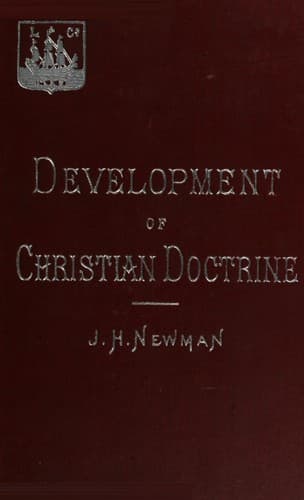
An Essay on the Development of Christian Doctrine — John Shaqi
An Essay on the Development of Christian DoctrineNewman, John Henry
Religion
An Essay on the Development of Christian Doctrine
Newman, John Henry
Catholic Church -- Doctrines; Dogma, Development of
2. Again, if Christianity be an universal religion, suited not simply to
one locality or period, but to all times and places, it cannot but vary
in its relations and dealings towards the world around it, that is, it
will develope. Principles require a very various application according
as persons and circumstances vary, and must be thrown into new shapes
according to the form of society which they are to influence. Hence all
bodies of Christians, orthodox or not, develope the doctrines of
Scripture. Few but will grant that Luther's view of justification had
never been stated in words before his time: that his phraseology and his
positions were novel, whether called for by circumstances or not. It is
equally certain that the doctrine of justification defined at Trent was,
in some sense, new also. The refutation and remedy of errors cannot
precede their rise; and thus the fact of false developments or
corruptions involves the correspondent manifestation of true ones.
Moreover, all parties appeal to Scripture, that is, argue from
Scripture; but argument implies deduction, that is, development. Here
there is no difference between early times and late, between a Pope _ex
cathedrâ_ and an individual Protestant, except that their authority is
not on a par. On either side the claim of authority is the same, and the
process of development.
Accordingly, the common complaint of Protestants against the Church of
Rome is, not simply that she has added to the primitive or the
Scriptural doctrine, (for this they do themselves,) but that she
contradicts it, and moreover imposes her additions as fundamental truths
under sanction of an anathema. For themselves they deduce by quite as
subtle a method, and act upon doctrines as implicit and on reasons as
little analyzed in time past, as Catholic schoolmen. What prominence has
the Royal Supremacy in the New Testament, or the lawfulness of bearing
arms, or the duty of public worship, or the substitution of the first
day of the week for the seventh, or infant baptism, to say nothing of
the fundamental principle that the Bible and the Bible only is the
religion of Protestants? These doctrines and usages, true or not, which
is not the question here, are surely not gained by the direct use and
immediate application of Scripture, nor by a mere exercise of argument
upon words and sentences placed before the eyes, but by the unconscious
growth of ideas suggested by the letter and habitual to the mind.
4.
Public-domain text, read in full here on John Shaqi.
Reviews
Reviews
No reviews yet
Be the first to share your thoughts on this work.
Join the Discussion
Join the discussion
Sign in to leave a comment or review.
Sign InorCreate an account