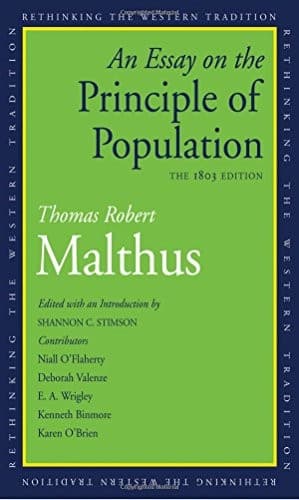
An Essay on the Principle of PopulationMalthus, T. R. (Thomas Robert)
Philosophy
An Essay on the Principle of Population
Malthus, T. R. (Thomas Robert)
Population
It will be said, perhaps, that the reason why plants and animals cannot
increase indefinitely in size is, that they would fall by their own
weight. I answer, how do we know this but from experience?--from
experience of the degree of strength with which these bodies are
formed. I know that a carnation, long before it reached the size of a
cabbage, would not be supported by its stalk, but I only know this from
my experience of the weakness and want of tenacity in the materials of
a carnation stalk. There are many substances in nature of the same size
that would support as large a head as a cabbage.
The reasons of the mortality of plants are at present perfectly unknown
to us. No man can say why such a plant is annual, another biennial, and
another endures for ages. The whole affair in all these cases, in
plants, animals, and in the human race, is an affair of experience, and
I only conclude that man is mortal because the invariable experience of
all ages has proved the mortality of those materials of which his
visible body is made:
What can we reason, but from what we know?
Sound philosophy will not authorize me to alter this opinion of the
mortality of man on earth, till it can be clearly proved that the human
race has made, and is making, a decided progress towards an illimitable
extent of life. And the chief reason why I adduced the two particular
instances from animals and plants was to expose and illustrate, if I
could, the fallacy of that argument which infers an unlimited progress,
merely because some partial improvement has taken place, and that the
limit of this improvement cannot be precisely ascertained.
Public-domain text, read in full here on John Shaqi.
Reviews
Reviews
No reviews yet
Be the first to share your thoughts on this work.
Join the Discussion
Join the discussion
Sign in to leave a comment or review.
Sign InorCreate an account