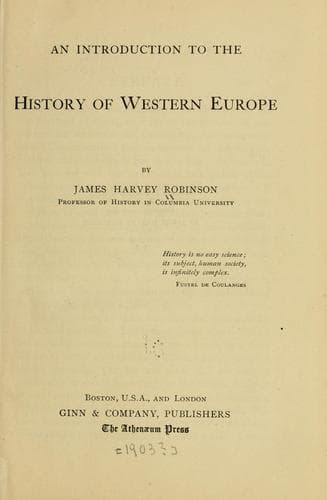
An Introduction to the History of Western Europe — John Shaqi
An Introduction to the History of Western EuropeRobinson, James Harvey
History
An Introduction to the History of Western Europe
Robinson, James Harvey
Europe -- History
The monks also helped to rescue honest manual labor, which they believed
to be a great aid to salvation, from the disrepute into which slavery
had brought it in earlier times. They set the example of careful
cultivation on the lands about their monasteries and in this way
introduced better methods into the regions where they settled. They
entertained travelers at a time when there were few or no inns and so
increased the intercourse between the various parts of Europe.[32]
[Sidenote: The regular and secular clergy.]
The Benedictine monks, as well as later monastic orders, were ardent and
faithful supporters of the papacy. The Roman Church, which owes much to
them, appreciated the aid which they might furnish and extended to them
many of the privileges enjoyed by the clergy. Indeed the monks were
reckoned as clergymen and were called the "regular" clergy because they
lived according to a _regula_, or rule, to distinguish them from the
"secular" clergy, who continued to live in the world (_saeculum_) and
took no monastic vows.
[Sidenote: Monks and secular clergy supplement each other.]
The Church, ever anxious to maintain as far-reaching a control over its
subjects as that of the Roman Empire, whose power it inherited, could
hardly expect its busy officers, with their multiform duties and
constant relations with men, to represent the ideal of contemplative
Christianity which was then held in higher esteem than the active life.
The secular clergy performed the ceremonies of the Church, administered
its business, and guarded its property, while the regular clergy
illustrated the necessity of personal piety and self-denial. Monasticism
at its best was a monitor standing beside the Church and constantly
warning it against permitting the Christian life to sink into mere
mechanical and passive acceptance of its ceremonies as all-sufficient
for salvation. It supplied the element of personal responsibility and
spiritual ambition upon which Protestantism has laid so much stress.
[Sidenote: The monks as missionaries.]
22. The first great service of the monks was their missionary labors. To
these the later strength of the Roman Church is in no small degree due,
for the monks made of the unconverted Germans not merely Christians, but
also dutiful subjects of the pope. The first people to engage their
attention were the heathen Germans who had conquered the once Christian
Britain.
[Sidenote: Early Britain.]
Public-domain text, read in full here on John Shaqi.
Reviews
Reviews
No reviews yet
Be the first to share your thoughts on this work.
Join the Discussion
Join the discussion
Sign in to leave a comment or review.
Sign InorCreate an account