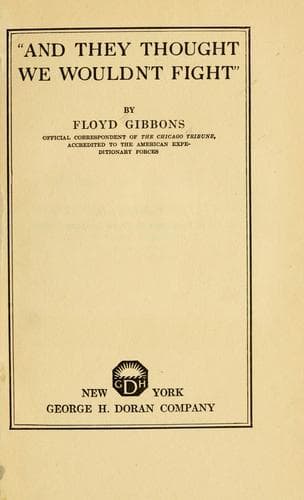
"And they thought we wouldn't fight"Gibbons, Floyd Phillips
History
"And they thought we wouldn't fight"
Gibbons, Floyd Phillips
World War, 1914-1918 -- Campaigns -- Western Front; World War, 1914-1918 -- Personal narratives
A driving rain which filled the valley with mist and made the hills look
like mountain tops projecting above the clouds, had resulted in the
abandonment of the usual daily drills. The men had spent the day in
billets writing letters home, hearing indoor lectures from instructors,
playing with the French children in the cottage doorways, or taking
lessons in French from the peasant girls, whose eyes were inspirations
to the dullest pupils.
I spent several hours in a company commander's quarters while he
censored letters which the men had submitted for transmission back home.
The Captain looked long at a letter in his hand, smiled and called for
his orderly.
"Tell Private Blank I want to see him here right away," were the
Captain's instructions. Blank's name was not quite so German as
Sourkraut, but it had a "berger" ending that was reminiscent of beer,
pretzels and wooden shoes.
"Here's a letter written in German," said the Captain to me, referring
to the open missive. "It's addressed to somebody by the same name as
Blank, and I presume it is to some one in his family. Blank is one of
the best men in my company, and I know that the letter is harmless, but
it is impossible for me to pass it when written in an enemy language."
The door opened and a tall, blonde enlisted man stepped in, shaking the
rain from his hat. He stood at respectful attention, saluted and said:
"Did the Captain wish to see me?"
"Yes, Blank, it is about this letter written in German," the Captain
replied. "Who is it addressed to?"
"My father, in Cincinnati, sir," Blank replied.
"I am unfamiliar with German," the Captain said. "I notice the letter is
brief. Is there anything in it which the company has been ordered to
omit mentioning?"
"No, sir," Blank replied.
"Will you translate it for me?" the Captain asked.
"Yes, sir," said Blank, with just a bare suggestion of a blush. Then he
read as follows:
"Dear Father: I am in good health. Food is good and we are learning
much. I am becoming an expert grenadier. In this village where we
are billeted there is a French girl named Germain. Before the war
she lived in northern France, near the German frontier, and she
speaks German. So it is possible for us to talk together. She fled
before the German troops reached her village. She lives here now
with her aunt.
"I carry water from a well for her and she has given me each day a
roll of fresh made butter for our mess. In the evening we sit on the
front seat of her uncle's small carriage, which is in the front
yard, and we imagine we are taking a drive, but of course there are
no horses. Her uncle's horses were taken by the army a long time
ago. She is very anxious to know all about America, and I have told
her all about you and mother and our home in Cincinnati.
Public-domain text, read in full here on John Shaqi.
Reviews
Reviews
No reviews yet
Be the first to share your thoughts on this work.
Join the Discussion
Join the discussion
Sign in to leave a comment or review.
Sign InorCreate an account