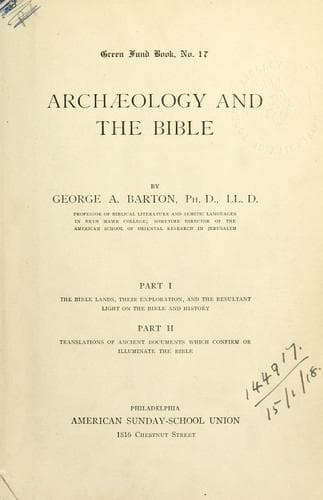
Archæology and the BibleBarton, George A. (George Aaron)
Religion
Archæology and the Bible
Barton, George A. (George Aaron)
Bible -- Antiquities; Egypt -- Antiquities; Middle East -- Antiquities
Although this dynasty furnished several other rulers, the leadership of
all Babylonia was lost after the death of Eannatum. It passed first to
Opis and then again to Kish. Lagash continued to flourish, however, during
200 years, while these cities were the overlords of its rulers. Its wars
had made it rich, and all the arts flourished there. Our best specimens of
terra-cotta and stone work come from this period of this city. Under
Entemena, the successor of Eannatum, a silver vase of exquisite
workmanship and ornamentation was made; (see Fig. 21). After a century or
more of wealth and luxury, during which priests and officials became
corrupt, a new king, Urkagina, seized the throne and endeavored to reform
the administration. Naturally, his reforms were unpopular with the
priesthood and the army, and, though popular with the people, he
unintentionally weakened the defensive power of his country.
At this juncture a new ruler named Lugalzaggisi arose in the city of Umma,
who ultimately overthrew Lagash and became king of all Babylonia. He made
Erech his capital. This was about 2800 B. C. Lugalzaggisi claims to have
overrun the country from the Persian Gulf to the Mediterranean. If so, and
there is no good reason to doubt his claim, Babylonia and the Palestinian
coast-lands were under him brought together for the first time.
After Lugalzaggisi the city of Agade came to the fore. Its great King
Sargon about 2775 B. C. founded a dynasty which ruled for nearly two
hundred years. The kings of this line were Semitic and resided sometimes
at Agade and sometimes at Kish. Sargon conquered Syria and a later
chronicle says that he crossed the western sea. As a seal of this dynasty
was found in Cyprus, it is possibly true. Naram-Sin, one of the most
famous kings of this line, conquered the country of Magan, which some
believe to be the peninsula of Sinai, but which others hold was situated
in eastern Arabia.
About the time of this dynasty, or a little before, King Lugaldaudu
flourished at Adab, the modern Bismya, where Dr. Banks found his statue.
In this same general period a king named Anubanini ruled in a city to the
northward, called Lulubi.
Perhaps it was under the later kings of this dynasty of Agade, or under a
dynasty of Erech which held sway for a brief period after them, that Gudea
flourished at Lagash. This ruler does not claim to be a king, but his city
enjoyed great prosperity under him, and he rebuilt it in fine style. He
seems to have been on peaceful terms with much of the world, and brought
for his structures stone from Magan, cedar wood from Amanus on the
Mediterranean coast, and copper from Lebanon. After this time the land was
overrun by hordes from Gutium, a region to the northeast beyond the
Tigris. They established a dynasty which lasted for 125 (or 159) years.
Public-domain text, read in full here on John Shaqi.
Reviews
Reviews
No reviews yet
Be the first to share your thoughts on this work.
Join the Discussion
Join the discussion
Sign in to leave a comment or review.
Sign InorCreate an account