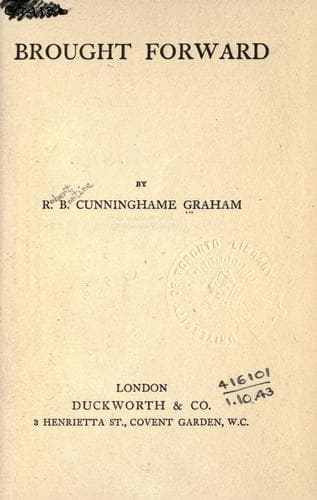
Brought ForwardCunninghame Graham, R. B. (Robert Bontine)
History
Brought Forward
Cunninghame Graham, R. B. (Robert Bontine)
Fiction; Short stories
Upon the forest tracks, from earliest dawn, long lines of white-clad
women, barefooted, with their black hair cut square across the forehead
and hanging down their backs, had marched as silently as ghosts. All of
them smoked great, green cigars, and as they marched along, their leader
carrying a torch, till the sun rose and jaguars went back to their lairs,
they never talked; but if a woman in the rear of the long line wished to
converse with any comrade in the front she trotted forward till she
reached her friend and whispered in her ear. When they arrived at the
crossing of the little river they bathed, or, at the least, washed
carefully, and gathering a bunch of flowers, stuck them into their hair.
They crossed the stream, and on arriving at the plaza they set the
baskets, which they had carried on their heads, upon the ground, and
sitting down beside them on the grass, spread out their merchandise.
Oranges and bread, called “chipa,” made from mandioca flour and cheese,
with vegetables and various homely sweetmeats, ground nuts, rolls of
sugar done up in plaintain leaves, and known as “rapadura,” were the
chief staples of their trade. Those who had asses let them loose to
feed; and if upon the forest trails the women had been silent, once in
the safety of the town no flight of parrots in a maize field could have
chattered louder than they did as they sat waiting by their wares. Soon
the square filled, and men arriving tied their horses in the shade,
slackening their broad hide girths, and piling up before them heaps of
the leaves of the palm called “Pindó” in Guarani, till they were cool
enough to eat their corn. Bands of boys, for in those days most of the
men had been killed off in the past war, came trooping in, accompanied by
crowds of women and of girls, who carried all their belongings, for there
were thirteen women to a man, and the youngest boy was at a premium
amongst the Indian women, who in the villages, where hardly any men were
left, fought for male stragglers like unchained tigresses. A few old men
came riding in on some of the few native horses left, for almost all the
active, little, undersized breed of Paraguay had been exhausted in the
war. They, too, had bands of women trotting by their sides, all of them
anxious to unsaddle, to take the horses down to bathe, or to perform any
small office that the men required of them. All of them smoked
continuously, and each of them was ready with a fresh cigarette as soon
as the old man or boy whom they accompanied finished the stump he held
between his lips. The women all were dressed in the long Indian shirt
called a “tupoi,” cut rather low upon the breast, and edged with coarse
black cotton lace, which every Paraguayan woman wore. Their hair was as
black as a crow’s back, and quite as shiny, and their white teeth so
strong that they could tear the ears of corn out of a maize cob like a
horse munching at his corn.
Public-domain text, read in full here on John Shaqi.
Reviews
Reviews
No reviews yet
Be the first to share your thoughts on this work.
Join the Discussion
Join the discussion
Sign in to leave a comment or review.
Sign InorCreate an account