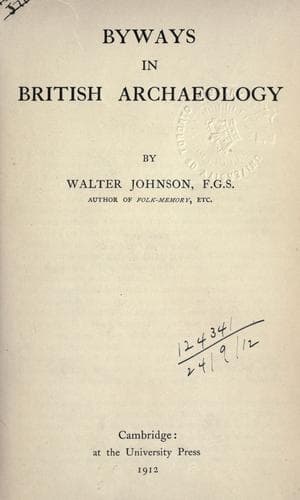
Christian antiquities -- Great Britain; Folklore -- Great Britain; Great Britain -- Antiquities
Some of the moot-hills, like that of Pirton (p. 60 _supra_), were Norman
mottes, though possibly not belonging wholly to the Norman period. It is
extremely probable, moreover, that some of the earlier mounds were
either actual British barrows, or were tumps raised for the specific use
of folk-moots. In other words, the first moot-hills would belong to
pagan times, and were therefore used long before the organization of
the Norman form of the manorial system, or the establishment of Norman
mottes. There is hence a likelihood that, where churches stand near
moot-hills, those mounds may, in some cases, be assigned to the
pre-Christian period. Nor would it greatly diminish this probability if
it were proved that some of these hillocks were entirely natural in
their formation. The force of the argument is derived from the fact that
secular affairs and heathen ceremonies were connected with the mounds,
and that it was thought wise to retain the bond by preaching the new
faith from a building erected in the vicinity.
A pertinent fact was observed by Mr James Logan, a generation ago. He
noticed that moot-hills were the seats of assemblies which afterwards
came to be held in churches[182]. Further, he discovered that
stone-circles were also formerly used for meetings: he thus anticipated
the conclusions of later writers. One remarkable instance is given. So
late as A.D. 1380, a Court of Regality was held “_apud le stand and
Stanes de la Rath de Kingusie_[183].” Of the moot-hills proper, Logan
found that these were often actually dedicated to saints. The Hill of
Scone was known as the _Collis Credulitatis_. Here we have obviously a
consecration due to the influence of Christianity. When, at a somewhat
later period, the custom was introduced of holding the courts in
churches, the clergy objected on the ground that the sacred building was
not suited to such a purpose. A canon was issued forbidding the laity to
hold such meetings within the church. These injunctions were frequently
disobeyed[184]. Up to this point, Logan is a safe guide, and his
theories can be justified by documentary evidence. He is supported, too,
by comparative customs. Professor F. Kauffmann, for instance, states
that the pagan temples of the West Teutons were situated near the places
of judgement, where the Things, or popular assemblies, were held[185].
The “doom-rings,” or stone-circles, of Iceland were used as judgement
seats down to a late period. Thus far, Logan’s view is corroborated.
But when, misled apparently by the Christian dedications just referred
to, he proceeds to argue that moot-hills were raised after the use of
churches was disallowed, he exactly reverses the order of events. The
stone-circles, according to his own presentment of facts, must have been
reared for the same cause, and, similarly, at a late period. One
suspects that vague ideas respecting the age of the megaliths led to a
hasty conclusion as to the age of the moot-hills. The real history would
Public-domain text, read in full here on John Shaqi.
Reviews
Reviews
No reviews yet
Be the first to share your thoughts on this work.
Join the Discussion
Join the discussion
Sign in to leave a comment or review.
Sign InorCreate an account