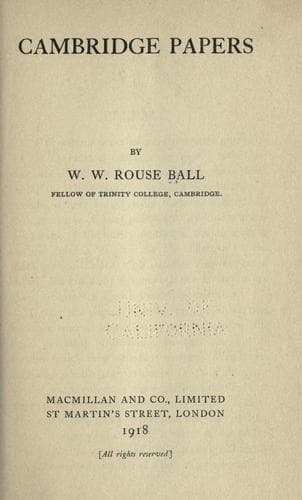
Cambridge PapersBall, W. W. Rouse (Walter William Rouse)
History
Cambridge Papers
Ball, W. W. Rouse (Walter William Rouse)
Trinity College (University of Cambridge); University of Cambridge -- History
The doggerel verses to which I have alluded as appearing in connection
with the struggle were, as far as I have seen them, poor stuff as
literary productions, and some were highly improper. The author of one
of the worst of them was discovered and expelled from the College,
12 March 1838. I possess copies of four or five of these productions,
their value consists entirely in giving us stories then current about
dons and things academic--stories, I may add, which appear generally
to have had no foundation in fact. The best set of verses, supposed to
be addressed on Saturday evening by a man to his bedmaker, is a parody
of Tennyson's _May Queen_. It begins: "You must mind and call me
early--call me early, d'ye hear? For I in morning chapel to-morrow
must appear," and on the whole runs easily. There is nothing in these
squibs which deserves remembrance or needs any further notice here.
There ends the story, and no comments on it or the actors in it are
needed. It may be added as a postscript, that for a long time
subsequent to this incident some attendance at chapel was required
from all who had no good reason to ask for exemption, and that as time
went on the requirements gradually grew less. The question of making
attendance at chapel compulsory on those who have not yet fully
attained years of discretion is admittedly difficult, and made more so
by the fact that while such attendance is approved and rigorously
imposed every day of the week at most public boarding schools on lads
up to the age of eighteen or nineteen, it is regarded as unthinkable
in the case of young graduates of twenty-one or so. Trinity College
finally adopted the view advocated by Thirlwall, and to-day attendance
at chapel services is voluntary.
CHAPTER V.
THE COLLEGE CHAPEL.
The College Chapel, as it appears to-day, is described in many of the
guide-books which are pressed on the casual traveller in Cambridge. I
am not here concerned with the accounts of it there given, for in this
paper I intend to deal with little beyond its history and traditions.
It is a matter of common knowledge that the present chapel was built
under the auspices of the Tudor queens, Mary and Elizabeth, on the
site of the old chapel of King's Hall. Let me begin by tracing briefly
the history of these successive buildings, and their connection with
college developments.
King's Hall owed its origin to the establishment of scholars in the
University of Cambridge by Edward II in 1317, and was put on a
permanent footing by Edward III in 1337. The original home of the
Society was a large two-storeyed house, built of wood and thatched,
bought from Robert de Croyland, and situated on the ground now
occupied by the walks and grass plot in front of the chapel. No chapel
or oratory was connected with it, and the Society worshipped in All
Saints' church which then stood on the green in Trinity Street facing
our present chapel.
Public-domain text, read in full here on John Shaqi.
Reviews
Reviews
No reviews yet
Be the first to share your thoughts on this work.
Join the Discussion
Join the discussion
Sign in to leave a comment or review.
Sign InorCreate an account