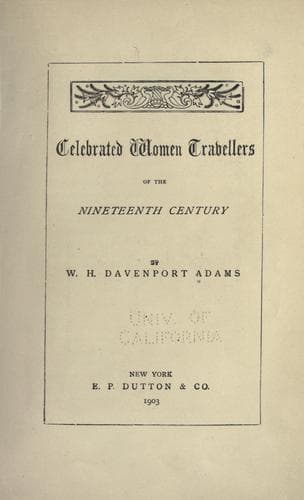
Celebrated Women Travellers of the Nineteenth CenturyAdams, W. H. Davenport (William Henry Davenport)
History
Celebrated Women Travellers of the Nineteenth Century
Adams, W. H. Davenport (William Henry Davenport)
Women travelers -- Biography
Like all pastoral people, the Kalmuks live frugally, because their wants
are few, and their nomadic life is unfavourable to the growth of a
liking for luxuries. They live chiefly upon milk and butter, with tea
for their favourite beverage. Their bill of fare also includes meat, and
particularly horse-flesh, which they prefer to any other, but they do
not eat it raw, as some writers have pretended. As for cereals, which
Europeans value so highly, their use is scarcely known; it is at rare
intervals only that some of them buy bread or oatcake from the
neighbouring Russians. Their mode of preparing tea would not commend
itself to the denizens of Mayfair. It comes to them from China in the
shape of very hard bricks, composed of the leaves and coarsest portions
of the plant. After boiling it for a considerable time in water, they
add milk, butter, and salt. The infusion then acquires consistency, and
a dull red colour. "We tasted the beverage," says Madame de Hell, "at
Prince Tumene's, but must confess it was perfectly detestable.... They
say, however, that one easily gets accustomed to it, and eventually
learns to think it delicious. It has, however, one good quality. By
strongly stimulating perspiration it serves as an excellent preservative
against the effect of sudden chills. The Kalmuks drink it out of round
shallow little wooden vessels, to which they often attach a very high
value. I have seen several," adds our traveller, "which were priced at
two or three horses. They are generally made of roots brought from Asia.
It is scarcely necessary to say that the Kalmuks know nothing of
tea-kettles, and make their beverage in large iron pots. Next to tea,
they love spirituous liquors. From mare's milk or ass's milk they
manufacture a kind of brandy; but as it is a very feeble stimulant, they
eagerly seek after Russian liquors; and therefore, to prevent the fatal
consequences of their mania, the government has forbidden the
establishment of any dram-shops among their hordes. The women crave the
deadly liquor no less ardently than the men, but are so closely watched
by their lords and masters that they have few opportunities of indulging
the taste."
Public-domain text, read in full here on John Shaqi.
Reviews
Reviews
No reviews yet
Be the first to share your thoughts on this work.
Join the Discussion
Join the discussion
Sign in to leave a comment or review.
Sign InorCreate an account