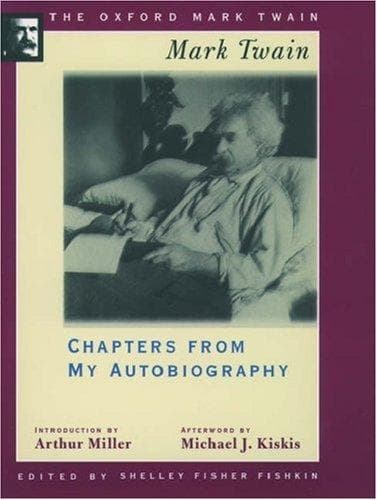
Authors, American -- 19th century -- Biography; Humorists, American -- 19th century -- Biography; Twain, Mark, 1835-1910
When the little Ruth was about a year or a year and a half old, Mason,
an old and valued friend of mine, was consul-general at
Frankfort-on-the-Main. I had known him well in 1867, '68 and '69, in
America, and I and mine had spent a good deal of time with him and his
family in Frankfort in '78. He was a thoroughly competent, diligent, and
conscientious official. Indeed he possessed these qualities in so large
a degree that among American consuls he might fairly be said to be
monumental, for at that time our consular service was largely--and I
think I may say mainly--in the hands of ignorant, vulgar, and incapable
men who had been political heelers in America, and had been taken care
of by transference to consulates where they could be supported at the
Government's expense instead of being transferred to the poor house,
which would have been cheaper and more patriotic. Mason, in '78, had
been consul-general in Frankfort several years--four, I think. He had
come from Marseilles with a great record. He had been consul there
during thirteen years, and one part of his record was heroic. There had
been a desolating cholera epidemic, and Mason was the only
representative of any foreign country who stayed at his post and saw it
through. And during that time he not only represented his own country,
but he represented all the other countries in Christendom and did their
work, and did it well and was praised for it by them in words of no
uncertain sound. This great record of Mason's had saved him from
official decapitation straight along while Republican Presidents
occupied the chair, but now it was occupied by a Democrat. Mr. Cleveland
was not seated in it--he was not yet inaugurated--before he was deluged
with applications from Democratic politicians desiring the appointment
of a thousand or so politically useful Democrats to Mason's place. A
year or two later Mason wrote me and asked me if I couldn't do something
to save him from destruction.
I was very anxious to keep him in his place, but at first I could not
think of any way to help him, for I was a mugwump. We, the mugwumps, a
little company made up of the unenslaved of both parties, the very best
men to be found in the two great parties--that was our idea of it--voted
sixty thousand strong for Mr. Cleveland in New York and elected him. Our
principles were high, and very definite. We were not a party; we had no
candidates; we had no axes to grind. Our vote laid upon the man we cast
it for no obligation of any kind. By our rule we could not ask for
office; we could not accept office. When voting, it was our duty to vote
for the best man, regardless of his party name. We had no other creed.
Vote for the best man--that was creed enough.
Public-domain text, read in full here on John Shaqi.
Reviews
Reviews
No reviews yet
Be the first to share your thoughts on this work.
Join the Discussion
Join the discussion
Sign in to leave a comment or review.
Sign InorCreate an account