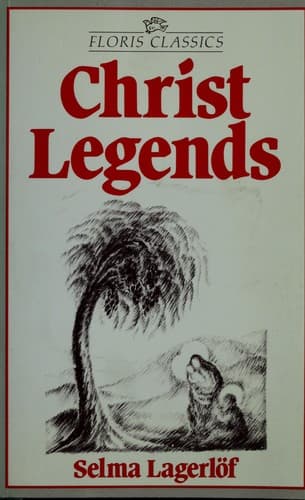
Jesus Christ -- Fiction; Jesus Christ -- Juvenile fiction; Short stories
Now and then she raised her eyes from the food and looked around,—as if
to try and realize that she was back in the hut. The poor old home with
its bare clay walls and its earth floor was certainly not much changed.
She pointed out to her hosts that on the walls there were still visible
some traces of dogs and deer which her father had sketched there to
amuse his little children. And on a shelf, high up, she thought she saw
fragments of an earthen dish which she herself had used to measure milk
in.
The man and his wife thought to themselves: “It must be true that she
was born in this hut, but she has surely had much more to attend to in
this life than milking goats and making butter and cheese.”
They observed also that her thoughts were often far away, and that she
sighed heavily and anxiously every time she came back to herself.
Finally she rose from the table. She thanked them graciously for the
hospitality she had enjoyed, and walked toward the door.
But then it seemed to the vine-dresser that she was pitifully poor and
lonely, and he exclaimed: “If I am not mistaken, it was not your
intention, when you dragged yourself up here last night, to leave this
hut so soon. If you are actually as poor as you seem, it must have been
your intention to remain here for the rest of your life. But now you
wish to leave because my wife and I have taken possession of the hut.”
The old woman did not deny that he had guessed rightly. “But this hut,
which for many years has been deserted, belongs to you as much as to
me,” she said. “I have no right to drive you from it.”
“It is still your parents’ hut,” said the laborer, “and you surely have
a better right to it than we have. Besides, we are young and you are
old; therefore, you shall remain and we will go.”
When the old woman heard this, she was greatly astonished. She turned
around on the threshold and stared at the man, as though she had not
understood what he meant by his words.
But now the young wife joined in the conversation.
“If I might suggest,” said she to her husband, “I should beg you to ask
this old woman if she won’t look upon us as her own children, and permit
us to stay with her and take care of her. What service would we render
her if we gave her this miserable hut and then left her? It would be
terrible for her to live here in this wilderness alone! And what would
she live on? It would be just like letting her starve to death.”
The old woman went up to the man and his wife and regarded them
carefully. “Why do you speak thus?” she asked. “Why are you so merciful
to me? You are strangers.”
Then the young wife answered: “It is because we ourselves once met with
great mercy.”
II
Public-domain text, read in full here on John Shaqi.
Reviews
Reviews
No reviews yet
Be the first to share your thoughts on this work.
Join the Discussion
Join the discussion
Sign in to leave a comment or review.
Sign InorCreate an account