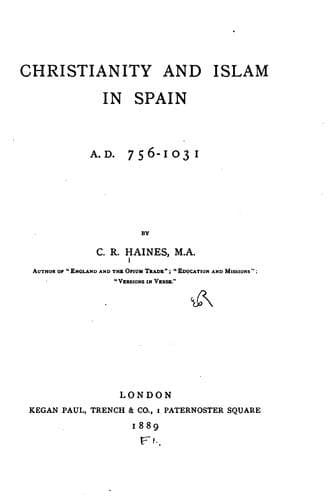
Christianity and Islam in Spain, A.D. 756-1031Haines, Charles Reginald
Islamic
Christianity and Islam in Spain, A.D. 756-1031
Haines, Charles Reginald
Christian martyrs -- Spain; Christianity -- Spain; Islam -- Spain
They then take counsel together how they may best effect their purpose,
there being evidently enough difficulty in procuring martyrdom for
themselves to shew the statements of the apologists, that there was a
fierce persecution raging, to be at least much exaggerated, if not
entirely without foundation. The plan decided upon, which the devisers
audaciously attributed to the suggestion of God,[1] was that the women
should go forth unveiled and with hurried steps to the church, in the
hope that such an unwonted sight would direct attention to them, and
occasion the arrest of the whole number. It fell out as desired, and
they were all brought before the judge, and interrogated with the usual
result, except that the judge on this occasion dismissed them with
scornful anger.[2] But George, disappointed at his untoward clemency, as
they were being led away broke out with,[3] "Can you not go down to hell
without seeking to drag us also thither as your companions?"
This incoherent abuse naturally incensed the soldiers, as it was no
doubt intended that it should. Accordingly the prisoners were dragged
again before the Kadi, who asked them in a mild tone of remonstrance,
why they had abandoned the faith of Islam,[4] and refused to live,
promising them at the same time great rewards, if they would become
Moslems again. On their refusal they were remanded for two days, which
seemed a very long time, so eager were they to die. They pass the time
with singing hymns, and are blessed with visits of angels and miraculous
signs. Their chains drop off, and the gaolers dare not again bind those
whom Christ Himself had loosed.[5] The authorities, now as ever, anxious
if possible to avoid extreme penalties, determine to release George,
because they had not themselves[6] heard his blasphemy. He baulks their
merciful intention by repeating his words on the spot, and he is
accordingly led forth and beheaded with the others (July 27, 852).
Within a month Christopher,[7] a monk of Rojana, and of Arab lineage,
and Leovigild, a monk of Fraga, both being places near Cordova, are
executed for the same offence and in the same manner, their dead bodies
being nailed to stakes. While taking the air in his palace,[8] the king
saw these bodies, and ordered them to be burnt, and the ashes scattered
in the river. The same night Abdurrahman II. was struck down with
apoplexy, and the martyrs' friends hailed it as a manifest judgment from
Heaven.
[1] Eulog., "Mem. Sanct.," ii. sec. 27. "Omnes in cornmuni
coepimus _cogitare quomodo ad desideratum perveniremus
coronam:_ et ita _Domino disfiensante_ visum est nobis ut
fugerent sorores nostrae revelatis vultibus ad ecclesiam si
forte nos alligandi daretur occasio, et ita factum est."
[2] _Ibid._, sec. 29. "Exite quibus vita praesens taedium est,
et mors pro gloria computatur."
Public-domain text, read in full here on John Shaqi.
Reviews
Reviews
No reviews yet
Be the first to share your thoughts on this work.
Join the Discussion
Join the discussion
Sign in to leave a comment or review.
Sign InorCreate an account