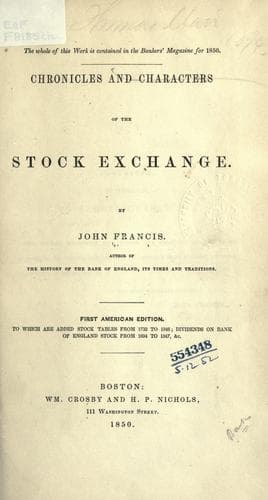
Chronicles and characters of the stock exchange — John Shaqi
Chronicles and characters of the stock exchangeFrancis, John, of the Bank of England
History
Chronicles and characters of the stock exchange
Francis, John, of the Bank of England
Speculation; Stock Exchange (London, England)
His principal dealings were in those tickets with which, from the
time of the second Charles, the seamen had been remunerated. After
years of great endurance and of greater labor, the defenders of the
land were paid with inconvertible paper, and the seamen—too often
improvident—were compelled to part with their wages at any discount
which the conscience of the usurer would offer. Men who had gone
the round of the world, like Drake, or had fought hand to hand with
Tromp, were unable to compete with the keen agent of the usurer, who,
decoying them into the low haunts of Rotherhithe, purchased their
tickets at the lowest possible price; and skilled seamen, the glory
of England’s navy, were thus robbed, and ruined, and compelled to
transfer their services to foreign states.
In these tickets did Thomas Guy deal; and on the wrongs of these
men was the vast superstructure of his fortune reared. But jobbing
in them was as frequent in the high places of England as in ’Change
Alley. The seaman was poor and uninfluential, and the orders which
were refused payment to him were paid to the wealthy jobber, who
parted with some of his plunder as a premium to the treasury to
disgorge the remainder. By these means, and by fortunate speculations
during the South-Sea bubble, Mr. Guy realized a fortune of £500,000.
It must be borne in mind, that, a century and a quarter ago, half a
million was almost a fabulous fortune. It was only to be acquired by
speculation in the funds, and by ventures which merely commercial
dealings failed to produce. In the literature of the past century,
a “plum” is mentioned as the great prize of a lifetime, and as the
extent of mercantile ambition. The enormous sums lately realized were
then almost unknown, or arose from some chivalrous adventure, such as
marked the lives of a Robert Clive or a Warren Hastings; and it was
left for the present century to witness the achievement of fortunes
which in the past would have been beyond credence.
In attaining so great a result, Mr. Guy was doubtless assisted by
his penurious habits; but he did not possess a penurious mind. The
endower of a princely charity, the founder of alms-houses, the
enricher of Christ’s Hospital, the support of his relations, and the
friend of the poor, must be regarded as one of those contradictory
characters which, at all periods and in all portions of the world,
have marked the human race. His dealings in the Stock Exchange were
continued to a late period of his existence. In 1720, he speculated
largely in the South-Sea Stock; and in 1724 he died, at the age of
eighty-one, leaving by will £240,000 to the hospital which bears his
name. His body lay in state at Mercer’s Chapel, was carried with
great funeral pomp to St. Thomas’s Hospital, and on February 13th,
1734, just ten years after his death, a statue was erected to his
memory in the square of that asylum, partially raised by profits from
the hard earnings of English seamen.
Public-domain text, read in full here on John Shaqi.
Reviews
Reviews
No reviews yet
Be the first to share your thoughts on this work.
Join the Discussion
Join the discussion
Sign in to leave a comment or review.
Sign InorCreate an account