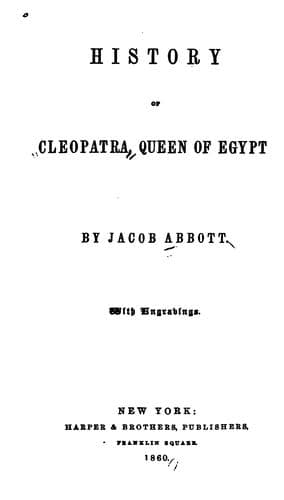
Cleopatra, Queen of Egypt, -30 B.C.; Egypt -- History -- 332-30 B.C. -- Biography; Queens -- Egypt -- Biography
power whatever. Thus, without the courage or the energy to attempt any
open, manly, and effectual system of hostility, he contented himself
with making all the difficulty in his power, by urging an incessant
pressure of petty, vexatious, and provoking, but useless annoyances.
Caesar's demands may have been unjust, but they were bold, manly, and
undisguised. The eunuch may have been right in resisting them; but the
mode was so mean and contemptible, that mankind have always taken part
with Caesar in the sentiments which they have formed as spectators of the
contest.
With the very small force which Caesar had at his command, and shut up as
he was in the midst of a very great and powerful city, in which both the
garrison and the population were growing more and more hostile to him
every day, he soon found his situation was beginning to be attended with
very serious danger. He could not retire from the scene. He probably
would not have retired if he could have done so. He remained, therefore,
in the city, conducting himself all the time with prudence and
circumspection, but yet maintaining, as at first, the same air of
confident self-possession and superiority which always characterized his
demeanor. He, however, dispatched a messenger forthwith into Syria, the
nearest country under the Roman sway, with orders that several legions
which were posted there should be embarked and forwarded to Alexandria
with the utmost possible celerity.
CHAPTER VI.
CLEOPATRA AND Caesar.
Cleopatra's perplexity.--She resolves To go to Alexandria.--Cleopatra's
message to Caesar.--Caesar's reply.--Apollodorus's stratagem.--Cleopatra
and Caesar--First impressions.--Caesar's attachment.--Caesar's wife.--His
fondness for Cleopatra.--Cleopatra's foes.--She commits her cause to
Caesar.--Caesar's pretensions.--He sends for Ptolemy.--Ptolemy's
indignation.--His complaints against Caesar.--Great tumult in the
city.--Excitement of the populace.--Caesar's forces--Ptolemy made
prisoner.--Caesar's address to the people.--Its effects.--The mob
dispersed.--Caesar convenes an assembly.--Caesar's decision.
--Satisfaction of the assembly.--Festivals and rejoicings.
--Pothinus and Achillas.--Plot of Pothinus and Achillas.--Escape
of Achillas.--March of the Egyptian army.--Measures of Caesar.
--Murder of the messengers.--Intentions of Achillas--Cold-blooded
assassination.--Advance of Achillas--Caesar's arrangements for
defense.--Cleopatra and Ptolemy.--Double dealing of Pothinus.--He is
detected.--Pothinus beheaded--Arsinoë and Ganymede--Flight of
Arsinoë--She is proclaimed queen by the army.--Perplexity of the young
Ptolemy.
Public-domain text, read in full here on John Shaqi.
Reviews
Reviews
No reviews yet
Be the first to share your thoughts on this work.
Join the Discussion
Join the discussion
Sign in to leave a comment or review.
Sign InorCreate an account