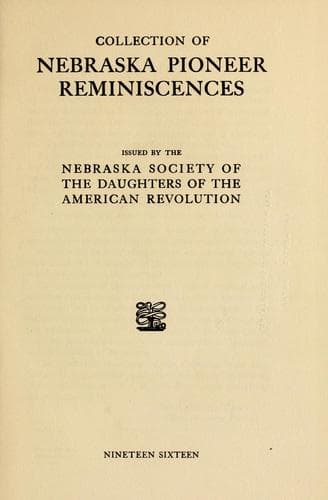
Collection of Nebraska Pioneer ReminiscencesDaughters of the American Revolution. Nebraska
History
Collection of Nebraska Pioneer Reminiscences
Daughters of the American Revolution. Nebraska
Frontier and pioneer life -- Nebraska; Nebraska -- History
One of the pleasures of the pioneer is hunting. In the early days there
was plenty of game in Dawson county, buffalo, elk, deer, antelope, jack
rabbits, and several game birds, such as plover, prairie hen, ducks,
geese, and cranes. By the time we arrived, however, the buffalo had been
driven so far away that they were seldom seen. There was plenty of
buffalo meat in the market, however, for hunters followed them and shot
them, mostly for their hides. The meat was very good, always tender and
of fine flavor. My father rushed into the house one day and called for
his revolver. A herd of buffalo was racing across the fields towards the
bluffs on the north. Father and some of the men with him, thought
possibly they might get near enough to shoot one. But although he rode
as fast as his pony could carry him, he could not get close enough and
the herd, once it reached the hills was safe. The poor beasts had been
chased for miles and were weary, but they did not give up. The cows
huddled the calves together and pushed them along and the bulls led the
way. Father learned afterward that his pony had been trained by the
Indians to hunt; and if he had given him the rein and allowed him to go
at it in his own way, he would have gone so close that father could have
shot one. But he did not know this until the buffalo were far away.
PIONEER JUSTICE
BY B. F. KRIER
In the early history of Lexington, Nebraska, as in all western states,
there was no crime committed more reprehensible than that of stealing a
horse. One might kill a man and it would be overlooked or excused, but
the offense of stealing a horse was a crime that nothing could atone for
but the "wiping out" of the thief. And generally when the horse thief
was caught the nearest tree or the upraised end of a wagon tongue was
immediately brought into use as a gallows upon which the criminal was
duly hanged without the formalities of courts or juries. It was amply
sufficient to know that the accused had stolen a horse, and it mattered
but little to whom the horse belonged or whether the owner was present
to take a hand in the execution. The culprit was dealt with in such
manner that he never stole another animal.
This sentiment prevailed among the first settlers of Dawson county, as
was shown in 1871, shortly after the organization of the county. Among
the officials of the county at that time was a justice of the peace, a
sturdy, honest man, who had been a resident of the county several years
before it was organized. One day in 1871 a half-breed Sioux came riding
from the east into Plum Creek (as Lexington was then called). The Indian
stopped in the town and secured a meal for himself and feed for his
horse.
Public-domain text, read in full here on John Shaqi.
Reviews
Reviews
No reviews yet
Be the first to share your thoughts on this work.
Join the Discussion
Join the discussion
Sign in to leave a comment or review.
Sign InorCreate an account