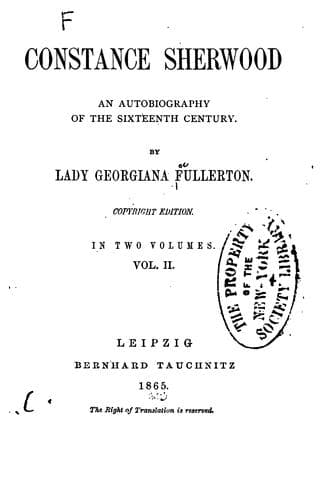
Constance Sherwood: An Autobiography of the Sixteenth Century — John Shaqi
Constance Sherwood: An Autobiography of the Sixteenth CenturyFullerton, Georgiana
History
Constance Sherwood: An Autobiography of the Sixteenth Century
Fullerton, Georgiana
Great Britain -- History -- Elizabeth, 1558-1603 -- Fiction
a messenger with a letter, wherein he wrote that the times were now so
troublesome, he must needs leave his home, and take advantage of the
sisterly favor she had willed to show him in the care of his sole
child, whom he now would forthwith send to London, commending her to
her good keeping, touching her safety and religious and virtuous
training, and that he should be more beholden to her than ever brother
was to sister, and, as long as he lived, as he was bound to do, pray
for her and her good husband. When this letter was gone, and order had
been taken for my journey, which was to be on horseback, and in the
charge of a maiden gentlewoman who had been staying some months in our
neighborhood, and was now about in two days to travel to London, it
seemed to me as if that which I had long expected and pictured unto
myself had now come upon me of a sudden, and in such wise as for the
first time to taste its bitterness. For I saw, without a doubt, that
this parting was but the forerunner of a change in my father's
condition as great and weighty as could well be thought of. But of
this howbeit our thoughts were full of it, no talk was ministered
between us. He said I should hear from him in London; and that he
should now travel into Lancashire and Cheshire, changing his name, and
often shifting his quarters whilst the present danger lasted. The day
which was to be the last to see us in the house wherein himself and
his fathers for many centuries back, and I his unworthy child, had
been born, was spent in such fashion as becometh those who suffer for
conscience sake, and that is with so much sorrow as must needs be felt
by a loving father and a dutiful child in a first and doubtful
parting, with so much regret as is natural in the abandonment of a
peaceful earthly home, wherein God had been served in a Catholic
manner for many generations and up to that time without
discontinuance, only of late years as it were by night and
stealth, which was linked in their memories with sundry innocent joys
and pleasures, and such griefs as do hallow and endear the visible
scenes wherewith they be connected, but withal with a stoutness of
heart in him, and a youthful steadiness in her whom he had infected
with a like courage unto his own, which wrought in them so as to be of
good cheer and shed no more tears on so moving an occasion than the
debility of her nature and the tenderness of his paternal care
extorted from their eyes when he placed her on her horse, and the
bridle in the hand of the servant who was to accompany her to London.
Their last parting was a brief one, and such as I care not to be
minute in describing; for thinking upon it even now 'tis like to make
me weep; which I would not do whilst writing this history, in the
recital of which there should be more of constancy and thankful
rejoicing in God's great mercies, than of womanish softness in looking
back to past trials. So I will even break off at this point; and in
Public-domain text, read in full here on John Shaqi.
Reviews
Reviews
No reviews yet
Be the first to share your thoughts on this work.
Join the Discussion
Join the discussion
Sign in to leave a comment or review.
Sign InorCreate an account