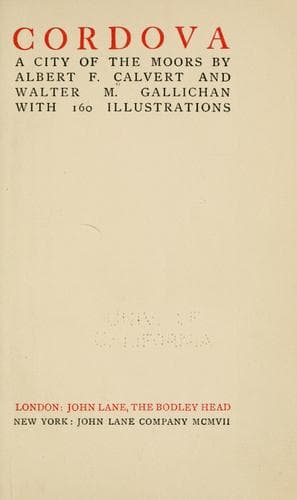
Cordova: A city of the MoorsCalvert, Albert Frederick
History
Cordova: A city of the Moors
Calvert, Albert Frederick
Arabs -- Spain; Córdoba (Spain) -- Description and travel; Córdoba (Spain) -- History
In the Christian Cathedral there are many examples of the composite
Moorish and Gothic architecture, which is known in Spain as the Estilo
Mudejar. Portraits of saints and paintings of living things were
introduced later, in contravention of the Mohammedan law forbidding such
representations in the decoration of holy buildings. Statues were also
placed in the Cathedral. The brilliant Plateresque style eventually
succeeded the later Mudejar work; the decorations were fanciful and
flamboyant, and not always inspired by the highest æsthetic sense.
Finally, in the seventeenth century, the Baroque style became the
fashion of the hour, and the arts of pictorial embellishment and of
carving degenerated often into the bizarre and the theatrical. Wood was
used in place of stone for statuary, and many of the fine old
altar-pieces in the Spanish churches were destroyed to give place to
grotesque and more ‘realistic’ conceptions.
As early as 1278 the minaret of Abd-er-Rahman III. was crowned with the
Christian figure of Saint Raphael, and at the time of the alterations
under the direction of Hernan Ruiz the bulk of the Moorish praying-tower
was removed, and the much loftier belfry erected. Most of the beautiful
doors of the Mosque were blocked up during the progress of the
reconstruction. The door of the Gate of Pardon was decorated by Henry
II., and is in the later Mudejar style, with Christian images above it.
Such are among the many examples of the curious blending of Moorish and
Christian forms of design and styles of ornamentation within and without
the Mosque.
For further examples of Mudejar architecture we may visit the Hospital
del Cardinal, where there is a fine chapel dedicated to San Bartolomé.
The Church of Santa Marina was originally Moorish, but it is now modern.
Relatives of the Gran Capitan Gonsalvo are buried in the San Hipolito.
VIII
THE PALACE OF THE KHALIFS AND THE MOORISH BRIDGE
Very little of the ancient Moorish Alcazar remains. On the south side
there are a bath and some towers, and the plot by the river is
beautifully shady with semi-tropical foliage and fruit-trees. The old
Alcazar was originally the Palace of the Khalifs, and it covered a large
area. It contained huge and sumptuous chambers and several handsome
baths, which were destroyed during the reign of Isabella. The northern
part of the building was erected in the time of Alfonso XI., about a
century after the recapture of Cordova by San Fernando.
The gate leading to the bridge is no longer Moorish. It was designed by
a Christian architect. We gain a glimpse of the sierras through the
portal, and passing through, reach the many-arched bridge, leading to
the Campo de la Verdad. The foundations are Roman, and it was probably
built in the time of Cæsar. At the far end is the Calahorra, a
picturesque tower. In the centre stands the shrine of the patron saint
of Cordova, St. Raphael, the archangel.
Public-domain text, read in full here on John Shaqi.
Reviews
Reviews
No reviews yet
Be the first to share your thoughts on this work.
Join the Discussion
Join the discussion
Sign in to leave a comment or review.
Sign InorCreate an account