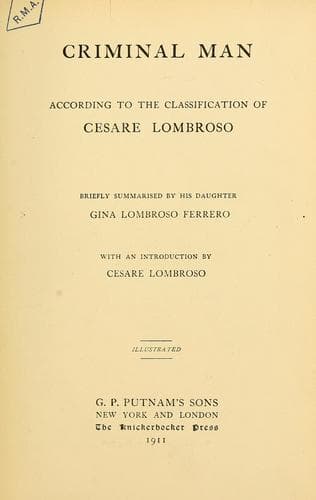
Criminal Man, According to the Classification of Cesare Lombroso — John Shaqi
Criminal Man, According to the Classification of Cesare LombrosoLombroso, Gina
Science
Criminal Man, According to the Classification of Cesare Lombroso
Lombroso, Gina
Criminal anthropology; Criminology
Maniacs are prone to satyriasis and bacchanalian excesses. They commit
rape and indecent acts in public and often appropriate strange objects,
hair or wearing apparel, with the idea of obtaining means to satisfy
their vices, either because they are unconscious of doing wrong or
because, like true megalomaniacs, they believe the stolen goods to be
their own property. Sometimes a feverish activity prompts them to
steal; "I felt a kind of uneasiness, a demon in my fingers," said one,
"which forced me to move them and carry off something."
Monomaniacs, especially if subject to hallucinations, frequently
manifest a tendency to homicide, either to escape imaginary persecutions
or in obedience to equally imaginary injunctions. The same motives prompt
them to commit special kinds of theft and arson. Na... (see Fig. 16)
murdered his friend without any reason, after suffering from
delusions for one year.
The characteristics of insane criminals are so marked that it is not
difficult to distinguish them from habitual delinquents. They seldom
show any fear of the penalty incurred nor do they try to escape. They
take little trouble to hide their misdeeds, or to get rid of any clue.
If poisoners, they leave poison about in their victim's room; if
forgers, they take no trouble to make their signatures appear genuine;
if thieves, they exhibit stolen goods in public, or appropriate them in
the presence of witnesses. They frequently manifest unbounded rage and
assault those present, entirely forgetting the stolen objects. Once
their crime is accomplished, not only do they give themselves no trouble
to hide it, but are prone to confess it immediately, and are eager to
talk about it, saying with satisfaction that they feel relieved at what
they have done, that they have obeyed the order of superior beings and
consider their actions praiseworthy. They deny that they are insane, or
if they admit it in some cases, it is only because they are persuaded to
do so by their lawyers or fellow-prisoners. And even then, they are
ready at the first opportunity to contradict the idea, eulogising and
exaggerating their criminal acts.
A full confession in court is not uncommon, and in the case of impulsive
monomaniacs, epileptics, and insane inebriates, the descriptions are
full of characteristic expressions, showing what was the offender's
state of mind when dominated by criminal frenzy.
Rom..., an impulsive monomaniac, who stabbed an acquaintance, felt "the
blood rushing to his head, which seemed to be in flames."
Tixier narrates that, on seeing the old man he afterward murdered pass
him on a country road, "something went to his head." Frequently such
criminals are quick to give themselves up to justice.
_Antecedents._ Unlike the ordinary offender, insane criminals are often
perfectly law-abiding up to the moment of the crime.
Public-domain text, read in full here on John Shaqi.
Reviews
Reviews
No reviews yet
Be the first to share your thoughts on this work.
Join the Discussion
Join the discussion
Sign in to leave a comment or review.
Sign InorCreate an account