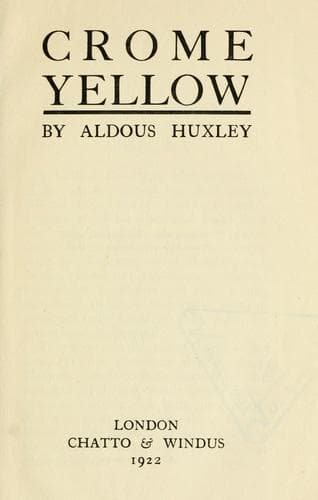
Country homes -- Fiction; England -- Fiction; Humorous stories; Intellectuals -- Fiction; Satire
“The Wimbushes and the Lapiths were always an unadventurous, respectable
crew,” said Priscilla, with a note of scorn in her voice. “If I were to
write my family history now! Why, it would be one long continuous blot
from beginning to end.” She laughed jovially, and helped herself to
another glass of wine.
“If I were to write mine,” Mr. Scogan remarked, “it wouldn’t exist.
After the second generation we Scogans are lost in the mists of
antiquity.”
“After dinner,” said Henry Wimbush, a little piqued by his wife’s
disparaging comment on the masters of Crome, “I’ll read you an episode
from my History that will make you admit that even the Lapiths, in their
own respectable way, had their tragedies and strange adventures.”
“I’m glad to hear it,” said Priscilla.
“Glad to hear what?” asked Jenny, emerging suddenly from her private
interior world like a cuckoo from a clock. She received an explanation,
smiled, nodded, cuckooed at last “I see,” and popped back, clapping shut
the door behind her.
Dinner was eaten; the party had adjourned to the drawing-room.
“Now,” said Henry Wimbush, pulling up a chair to the lamp. He put on
his round pince-nez, rimmed with tortoise-shell, and began cautiously
to turn over the pages of his loose and still fragmentary book. He found
his place at last. “Shall I begin?” he asked, looking up.
“Do,” said Priscilla, yawning.
In the midst of an attentive silence Mr. Wimbush gave a little
preliminary cough and started to read.
“The infant who was destined to become the fourth baronet of the name of
Lapith was born in the year 1740. He was a very small baby, weighing not
more than three pounds at birth, but from the first he was sturdy and
healthy. In honour of his maternal grandfather, Sir Hercules Occam of
Bishop’s Occam, he was christened Hercules. His mother, like many other
mothers, kept a notebook, in which his progress from month to month was
recorded. He walked at ten months, and before his second year was out
he had learnt to speak a number of words. At three years he weighed but
twenty-four pounds, and at six, though he could read and write perfectly
and showed a remarkable aptitude for music, he was no larger and heavier
than a well-grown child of two. Meanwhile, his mother had borne two
other children, a boy and a girl, one of whom died of croup during
infancy, while the other was carried off by smallpox before it reached
the age of five. Hercules remained the only surviving child.
Public-domain text, read in full here on John Shaqi.
Reviews
Reviews
No reviews yet
Be the first to share your thoughts on this work.
Join the Discussion
Join the discussion
Sign in to leave a comment or review.
Sign InorCreate an account