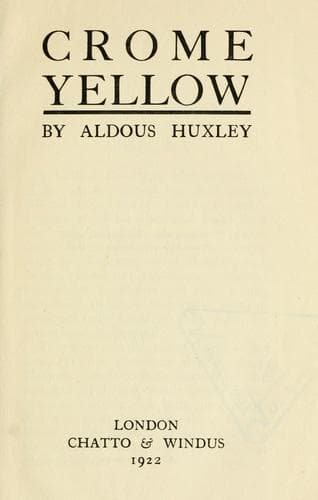
Country homes -- Fiction; England -- Fiction; Humorous stories; Intellectuals -- Fiction; Satire
“Hercules thus found himself at the age of twenty-one alone in the
world, and master of a considerable fortune, including the estate and
mansion of Crome. The beauty and intelligence of his childhood had
survived into his manly age, and, but for his dwarfish stature, he would
have taken his place among the handsomest and most accomplished young
men of his time. He was well read in the Greek and Latin authors, as
well as in all the moderns of any merit who had written in English,
French, or Italian. He had a good ear for music, and was no indifferent
performer on the violin, which he used to play like a bass viol, seated
on a chair with the instrument between his legs. To the music of the
harpsichord and clavichord he was extremely partial, but the smallness
of his hands made it impossible for him ever to perform upon these
instruments. He had a small ivory flute made for him, on which,
whenever he was melancholy, he used to play a simple country air or jig,
affirming that this rustic music had more power to clear and raise the
spirits than the most artificial productions of the masters. From an
early age he practised the composition of poetry, but, though conscious
of his great powers in this art, he would never publish any specimen of
his writing. ‘My stature,’ he would say, ‘is reflected in my verses; if
the public were to read them it would not be because I am a poet,
but because I am a dwarf.’ Several MS. books of Sir Hercules’s poems
survive. A single specimen will suffice to illustrate his qualities as a
poet.”
“‘In ancient days, while yet the world was young,
Ere Abram fed his flocks or Homer sung;
When blacksmith Tubal tamed creative fire,
And Jabal dwelt in tents and Jubal struck the lyre;
Flesh grown corrupt brought forth a monstrous birth
And obscene giants trod the shrinking earth,
Till God, impatient of their sinful brood,
Gave rein to wrath and drown’d them in the Flood.
Teeming again, repeopled Tellus bore
The lubber Hero and the Man of War;
Huge towers of Brawn, topp’d with an empty Skull,
Witlessly bold, heroically dull.
Long ages pass’d and Man grown more refin’d,
Slighter in muscle but of vaster Mind,
Smiled at his grandsire’s broadsword, bow and bill,
And learn’d to wield the Pencil and the Quill.
The glowing canvas and the written page
Immortaliz’d his name from age to age,
His name emblazon’d on Fame’s temple wall;
For Art grew great as Humankind grew small.
Thus man’s long progress step by step we trace;
The Giant dies, the hero takes his place;
The Giant vile, the dull heroic Block:
At one we shudder and at one we mock.
Public-domain text, read in full here on John Shaqi.
Reviews
Reviews
No reviews yet
Be the first to share your thoughts on this work.
Join the Discussion
Join the discussion
Sign in to leave a comment or review.
Sign InorCreate an account