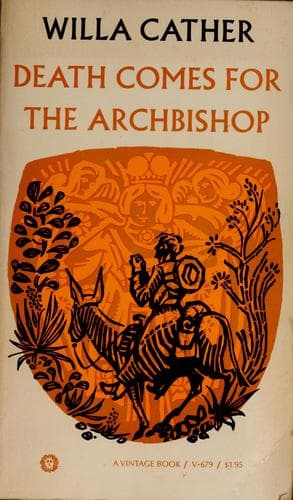
Christian fiction; Clergy -- Fiction; Historical fiction; New Mexico -- Fiction
The young Indian said that supper was ready, and the Bishop followed him
to his particular lair in those rows of little houses all alike and all
built together. There was a ladder before Jacinto's door which led up to
a second storey, but that was the dwelling of another family; the roof
of Jacinto's house made a veranda for the family above him. The Bishop
bent his head under the low doorway and stepped down; the floor of the
room was a long step below the doorsill--the Indian way of preventing
drafts. The room into which he descended was long and narrow, smoothly
whitewashed, and clean, to the eye, at least, because of its very
bareness. There was nothing on the walls but a few fox pelts and strings
of gourds and red peppers. The richly coloured blankets of which Jacinto
was very proud were folded in piles on the earth settle,--it was there
he and his wife slept, near the fire-place. The earth of that settle
became warm during the day and held its heat until morning, like the
Russian peasants' stove-bed. Over the fire a pot of beans and dried meat
was simmering. The burning piñon logs filled the room with
sweet-smelling smoke. Clara, Jacinto's wife, smiled at the priest as he
entered. She ladled out the stew, and the Bishop and Jacinto sat down on
the floor beside the fire, each with his bowl. Between them Clara put a
basin full of hot corn-bread baked with squash seeds,--an Indian
delicacy comparable to raisin bread among the whites. The Bishop said a
blessing and broke the bread with his hands. While the two men ate, the
young woman watched them and stirred a tiny cradle of deerskin which
hung by thongs from the roof poles. Jacinto, when questioned, said sadly
that the baby was ailing. Father Latour did not ask to see it; it would
be swathed in layers of wrappings, he knew; even its face and head would
be covered against drafts. Indian babies were never bathed in winter,
and it was useless to suggest treatment for the sick ones. On that
subject the Indian ear was closed to advice.
It was a pity, too, that he could do nothing for Jacinto's baby. Cradles
were not many in the pueblo of Pecos. The tribe was dying out; infant
mortality was heavy, and the young couples did not reproduce
freely,--the life-force seemed low. Smallpox and measles had taken heavy
toll here time and again.
Public-domain text, read in full here on John Shaqi.
Reviews
Reviews
No reviews yet
Be the first to share your thoughts on this work.
Join the Discussion
Join the discussion
Sign in to leave a comment or review.
Sign InorCreate an account