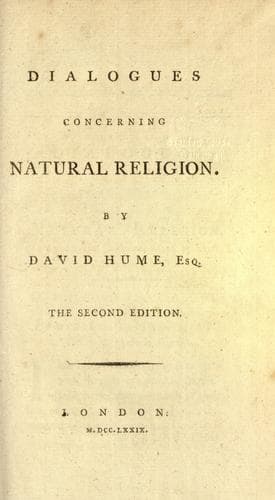
Natural theology -- Early works to 1800; Religion -- Early works to 1800
If you feel not human misery yourself, cried DEMEA, I congratulate you on
so happy a singularity. Others, seemingly the most prosperous, have not
been ashamed to vent their complaints in the most melancholy strains. Let
us attend to the great, the fortunate emperor, CHARLES V, when, tired
with human grandeur, he resigned all his extensive dominions into the
hands of his son. In the last harangue which he made on that memorable
occasion, he publicly avowed, that the greatest prosperities which he had
ever enjoyed, had been mixed with so many adversities, that he might
truly say he had never enjoyed any satisfaction or contentment. But did
the retired life, in which he sought for shelter, afford him any greater
happiness? If we may credit his son's account, his repentance commenced
the very day of his resignation.
CICERO's fortune, from small beginnings, rose to the greatest lustre and
renown; yet what pathetic complaints of the ills of life do his familiar
letters, as well as philosophical discourses, contain? And suitably to
his own experience, he introduces CATO, the great, the fortunate CATO,
protesting in his old age, that had he a new life in his offer, he would
reject the present.
Ask yourself, ask any of your acquaintance, whether they would live over
again the last ten or twenty years of their life. No! but the next
twenty, they say, will be better:
And from the dregs of life, hope to receive
What the first sprightly running could not give.
Thus at last they find (such is the greatness of human misery, it
reconciles even contradictions), that they complain at once of the
shortness of life, and of its vanity and sorrow.
And is it possible, CLEANTHES, said PHILO, that after all these
reflections, and infinitely more, which might be suggested, you can still
persevere in your Anthropomorphism, and assert the moral attributes of
the Deity, his justice, benevolence, mercy, and rectitude, to be of the
same nature with these virtues in human creatures? His power we allow is
infinite: whatever he wills is executed: but neither man nor any other
animal is happy: therefore he does not will their happiness. His wisdom
is infinite: He is never mistaken in choosing the means to any end: But
the course of Nature tends not to human or animal felicity: therefore it
is not established for that purpose. Through the whole compass of human
knowledge, there are no inferences more certain and infallible than
these. In what respect, then, do his benevolence and mercy resemble the
benevolence and mercy of men?
EPICURUS's old questions are yet unanswered. Is he willing to prevent evil,
but not able? then is he impotent. Is he able, but not willing? then is he
malevolent. Is he both able and willing? whence then is evil?
Public-domain text, read in full here on John Shaqi.
Reviews
Reviews
No reviews yet
Be the first to share your thoughts on this work.
Join the Discussion
Join the discussion
Sign in to leave a comment or review.
Sign InorCreate an account