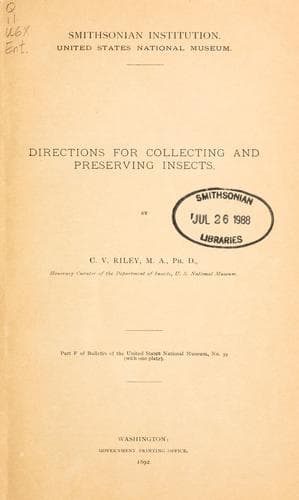
Directions for Collecting and Preserving InsectsRiley, Charles V. (Charles Valentine)
Science
Directions for Collecting and Preserving Insects
Riley, Charles V. (Charles Valentine)
Insects -- Collection and preservation
I go out with a coat provided with large pockets inside and out,
containing an assortment of pill-boxes, generally of three sizes,
glass-bottomed pill-boxes preferred, a bag slung over my shoulder, and a
net. Unless searching for particular day-flying species, I prefer the
last three hours before dark. As the sun goes down many species move
which do not stir at other times. I watch the tops of the grass, the
stems of the flowers, the twigs of the trees; I disturb leaves and
low-growing plants with a short switch and secure each little moth that
moves, taking each out of the net in a separate pill-box, selected
according to the size of the insect, as he runs up the net to escape.
Transferring the full boxes to the bag I continue the process until
moths cease flying or night sets in. Many species can be taken with a
lamp after dark.
_Collecting the early States._--The careful entomologist who prides
himself on the appearance of his specimens, will, as stated above, rely
largely on collecting the early states and on rearing the insects, for
his material. The Macrolepidoptera have either a single or two broods,
or more, in a season, and the collection of the early states will be
greatly facilitated if a knowledge of the insect's life-habits is first
obtained. The eggs are often found on the food plants of the species,
and where they are deposited in masses they afford a very easy method of
getting the larvae in numbers. In many cases, however, the eggs are
deposited singly and their discovery then becomes a difficult matter.
Public-domain text, read in full here on John Shaqi.
Reviews
Reviews
No reviews yet
Be the first to share your thoughts on this work.
Join the Discussion
Join the discussion
Sign in to leave a comment or review.
Sign InorCreate an account