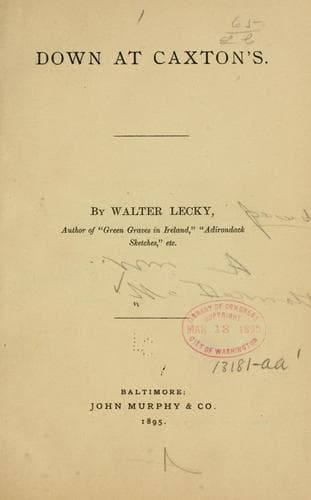
American literature -- 19th century -- History and criticism; American literature -- Catholic authors -- History and criticism
Her sketches are the agreeable jottings of a highly cultivated woman;
seeing nature in the light of poetry rather than science, she has made
a series of charming pictures out of her wanderings. They are not free
from sentiment,—illusions if you will, but that is their greatest
charm. “The world of reality is a poor affair.” So many books of travel
are annually appearing,—books that have no excuse for being other than
to prove how widespread dulness and incapacity is, that a trip with a
guide like Mrs. Blake has but one failing,—its shortness. Neither in
her travels nor in her literary articles does Mrs. Blake body forth her
best prose utterance. These must be found in her earnest social papers,
where her woman’s heart, saddened by the miseries of its fellows, pours
out its streams of consolation and preaches (all earnest souls must be
preachers now-a-days) the only and all sufficient cure—the Church.
An extract from one of these papers will best show her power. She is
portraying the Church manifesting itself in the individual as well
as the family life, pleading for the central idea of her system.
“Jesus Christ is the complement of man,”—the restorer of the race. The
Catholic Church is the manifestation of Jesus Christ.
“There are, alas! too many weaknesses into which thoughtlessness and
opportunity lead one class as well as the other. But still there is
to be seen almost without exception, among practical Catholics, young
wives, content and happy, welcoming from the very outset of married
life the blessed company of the little ones who are to guard them
as do their angels in heaven; proud like Cornelia of their jewels;
gladly accepting comparative poverty and endless care; while their
sisters outside the Church buy the right to idleness and personal
adorning at the expense of the childless homes which are a disgrace and
menace to the nation. There is the honor and purity of the fireside
respected; the overpowering sweetness and strength of family ties
acknowledged; the reverential love that awaits upon the father and
mother shown. There are sensitive and refined women bearing sorrow
with resignation and hardship without rebellion; combating pain with
patience and fulfilling harsh duty without complaint. In a tremendous
over-proportion to those who attempt to live outside its helpfulness,
and in exact ratio to their practical devotion to the observances
of the Church, they find power of resisting temptation in spite of
poverty, and overcoming impulse by principle. Can the world afford to
ignore an agency by which so much is accomplished?
Public-domain text, read in full here on John Shaqi.
Reviews
Reviews
No reviews yet
Be the first to share your thoughts on this work.
Join the Discussion
Join the discussion
Sign in to leave a comment or review.
Sign InorCreate an account