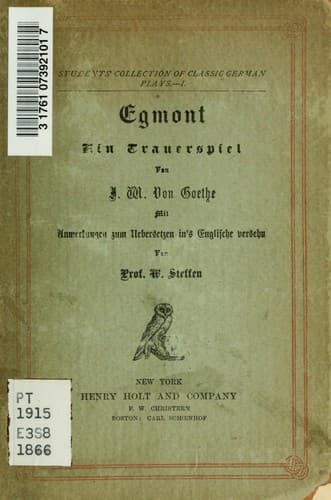
Egmont, Lamoraal, Graaf van, 1522-1568 -- Drama; Tragedies (Drama)
Alva (who during this speech has looked round several times). Would you
venture to repeat what you have uttered, in the king's presence?
Egmont. It were the worse, if in his presence I were restrained by
fear! The better for him and for his people, if he inspired me with
confidence, if he encouraged me to give yet freer utterance to my
thoughts.
Alva. What is profitable, I can listen to as well as he.
Egmont. I would say to him--'Tis easy for the shepherd to drive before
him a flock of sheep; the ox draws the plough without opposition; but
if you would ride the noble steed, you must study his thoughts, you must
require nothing unreasonable, nor unreasonably, from him. The burgher
desires to retain his ancient constitution; to be governed by his own
countrymen; and why? Because he knows in that case how he shall be
ruled, because he can rely upon their disinterestedness, upon their
sympathy with his fate.
Alva. And ought not the Regent to be empowered to alter these ancient
usages? Should not this constitute his fairest privilege? What is
permanent in this world? And shall the constitution of a state alone
remain unchanged? Must not every relation alter in the course of time,
and on that very account, an ancient constitution become the source of
a thousand evils, because not adapted to the present condition of the
people? These ancient rights afford, doubtless, convenient loopholes,
through which the crafty and the powerful may creep, and wherein
they may lie concealed, to the injury of the people and of the entire
community; and it is on this account, I fear, that they are held in such
high esteem.
Egmont. And these arbitrary changes, these unlimited encroachments of
the supreme power, are they not indications that one will permit himself
to do what is forbidden to thousands? The monarch would alone be free,
that he may have it in his power to gratify his every wish, to realize
his every thought. And though we should confide in him as a good and
virtuous sovereign, will he be answerable to us for his successor?
That none who come after him shall rule without consideration, without
forbearance! And who would deliver us from absolute caprice, should he
send hither his servants, his minions, who, without knowledge of the
country and its requirements, should govern according to their own good
pleasure, meet with no opposition, and know themselves exempt from all
responsibility?
Alva (who has meanwhile again looked round). There is nothing more
natural than that a king should choose to retain the power in his own
hands, and that he should select as the instruments of his authority,
those who best understand him, who desire to understand him, and who
will unconditionally execute his will.
Egmont. And just as natural is it, that the burgher should prefer being
governed by one born and reared in the same land, whose notions of right
and wrong are in harmony with his own, and whom he can regard as his
brother.
Public-domain text, read in full here on John Shaqi.
Reviews
Reviews
No reviews yet
Be the first to share your thoughts on this work.
Join the Discussion
Join the discussion
Sign in to leave a comment or review.
Sign InorCreate an account