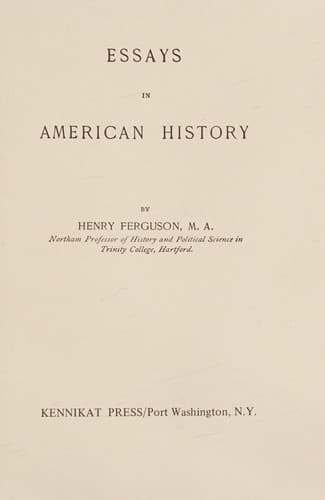
American loyalists; Andros, Edmund, Sir, 1637-1714; Society of Friends -- New England; Witchcraft -- New England
Though we talk of the progress that the race has made in learning
and enlightenment, it is alarming to notice how ineradicable are the
superstitions of mankind, how germs which men deem dead really lurk
dormant for ages, and then develop themselves with startling rapidity
when they find the proper menstruum. Man, like other animals, seems to
exhibit a tendency from time to time to revert to the original type,
and to reproduce the physiognomy of long-perished races, with their
fears and their hatreds, their low spiritual conceptions and their
dominant animal passions. It is the work of education, of civilization,
and of religion to strive against this tendency. We can only hope that
as men have, in spite of this, made steady progress in many directions,
and have conquered and are conquering the animal that is in them,
they may in time get the better of all the evil legacies which their
primeval ancestors have bequeathed them. Modern science has removed
the fear of the plague in all civilized countries and is lessening the
danger of the cholera; in like manner, we may hope the old terrors will
also in time be swept away, and man be freed from any danger of their
recurrence.
NOTES.
[51] Even Winthrop, the governor of Massachusetts, wise and good as he
was, recorded in his _History_ his direful forebodings occasioned by
the appearance of a monstrosity which the unfortunate Mary Dyer, who
was afterwards hanged as a Quaker, had brought into the world. _History
of New England_, i. 261–3.
[52] _Demonologie, in forme of a dialogue_, 1st Ed., Edinburgh, 1597,
4to.
[53] 1 Jac. I. c. 12.
[54] _State Trials_, vol. ii. pp. 786–862.
[55] Baxter, Richard, D. D., _The Certainty of the Worlds of Spirits_,
p. 53.
[56] _A Tryal of Witches_, printed 1682, published with a treatise of
Sir Matthew Hale’s on _Sheriffs’ Accompts_, London, 1683. Sir Matthew’s
charge was to the following effect: “That he would not repeat the
Evidence unto them, least by so doing he should wrong the Evidence on
the one side or on the other. Only this acquainted them, That they had
Two things to enquire after. _First_, whether or no these children were
bewitched? _Secondly_, whether the Prisoners at the Bar were Guilty
of it. That there were such Creatures as Witches he made no doubt at
all; For, _First_, the Scriptures had affirmed so much. _Secondly_, The
Wisdom of all Nations had provided laws against such persons, which is
an argument of their confidence in such a Crime. And such hath been the
judgment of this Kingdom, as appears by that Act of Parliament which
hath provided Punishments proportionable to the quality of the offense.
And desired them strictly to observe their Evidence; and desired the
great God of Heaven to direct their Hearts in this weighty thing they
had in hand: For to condemn the Innocent, and to let the Guilty go
free, were both an abomination unto the Lord.” (pp. 55, 56.)
[57] _A Tryal of Witches_, pp. 41, 42.
Public-domain text, read in full here on John Shaqi.
Reviews
Reviews
No reviews yet
Be the first to share your thoughts on this work.
Join the Discussion
Join the discussion
Sign in to leave a comment or review.
Sign InorCreate an account