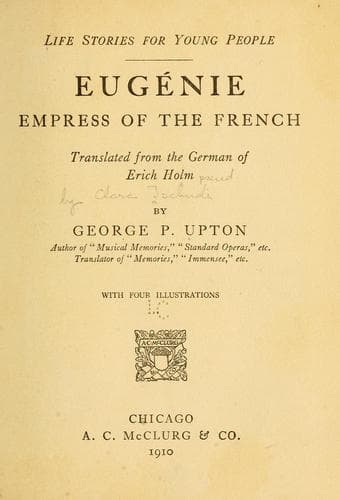
Eugénie, Empress, consort of Napoleon III, Emperor of the French, 1826-1920; Napoleon III, Emperor of the French, 1808-1873 -- Marriage
Napoleon chose the former course. At the general election of 1870, the
change from an autocratic to a constitutional government was approved by
about eight million votes. For the other alternative he had a decided
distaste. His watchword, “empire is peace,” was no empty phrase on his
lips, in spite of the wars into which he had been forced by policy. When
at the victorious battle of Solferino he saw whole ranks of Austrians
mowed down by his artillery, he ordered the firing to cease, in spite of
the protests of his officers; and long afterwards he could never think
or speak of this bloody engagement without a shudder. One of his most
cherished plans was to bring about a general disarmament of all the
great powers, and a presentiment that his ruin was near at hand made him
the more averse to any conflict with Prussia. The pressure in favor of
it grew steadily greater, however, and, weary of the burden of
government, ill in body and mind, he finally yielded. War was declared
on the most trivial pretext, July 14, 1870.
Heretofore the French people had shown no special interest in the
subject, and the news came as a surprise; yet once the die was cast, the
prospect of war excited the wildest enthusiasm. The Emperor and Empress
were greeted with acclamation: the horses were taken from their coach
and drawn by the youth of France; the imperial pair rode in triumph
through the streets of Paris. The whole nation was aroused. Volunteers
flocked to the banner of France. Shouts of, “To Berlin! To Berlin!” and
the strains of the Marseillaise, filled the air. The ferment that had
long been brewing having now found an outlet, the riotous element
hastened to the frontier. Every day fresh bodies of troops departed.
Paris was in high spirits, and news from the seat of war was awaited
with confident assurance. From day to day it was expected that the
Emperor would join the army; but it was not till the twenty-eighth of
July that he finally took his departure, leaving his wife as Regent
during his absence, and accompanied by the Prince Imperial, who was to
have his first experience of warfare.
Public-domain text, read in full here on John Shaqi.
Reviews
Reviews
No reviews yet
Be the first to share your thoughts on this work.
Join the Discussion
Join the discussion
Sign in to leave a comment or review.
Sign InorCreate an account