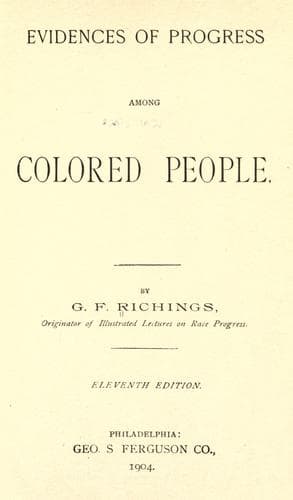
Evidences of Progress Among Colored People — John Shaqi
Evidences of Progress Among Colored PeopleRichings, G. F.
History
Evidences of Progress Among Colored People
Richings, G. F.
African Americans
An industrial and high-grade school for girls, is located in the
historic town of Camden, S. C., within the bounds of the district. The
work done there and the discipline are so thorough that it deserves
more than mere mention. The Home was built in 1887 by the Woman's Home
Missionary Society of the M. E. Church, to educate girls and young
women along the line of practical housekeeping. Since the opening of
the school, about one hundred and twenty-five have received training.
Connected with the Home is a day-school of high grade, having a regular
course of study, from which three classes have graduated. The school
this year is well attended, having an enrollment of over two hundred;
and thirty-seven girl boarders in the Home.
The Home will be enlarged so as to accommodate all who may come. Total
expenses for board and tuition, five dollars per month.
Mrs. Gordon, the superintendent, and her _corps_ of teachers, are a
noble band of self-sacrificing women, who came from the North. They
have been the subjects of opposition, and abuse, and ostracism, in
their efforts to elevate a downtrodden people, and they deserve, and
ought to have, the patronage, sympathy, and good-will of all.
GAMMON THEOLOGICAL SEMINARY.
Gammon Theological Seminary, at Atlanta, Georgia, is the largest
theological school for the exclusive education of colored men in
the United States. It stands to-day a monument to the philanthropy
of Elijah H. Gammon, of Maine, a noble gentleman, who endowed the
school with nearly half a million dollars. Dr. Gammon was certainly
a philanthropist. This fact is plainly indicated by his splendid
beneficence.
He did not wait till in sight of the grave and then cast off his
wealth as a possession he could no longer use; but _living_, he
poured out his treasures; yea, more, he gave the ripe thought of his
last years--planned and wrought for the equipment of this Seminary.
The measure of his philanthropy is not in that he gave $10,000 to
Garrett, $5,000 to the Maine Wesleyan, thousands to churches and aid
to many struggling students. The mere catalogue of benefactions is no
measure of the real philanthropist. The _man himself_, his motive,
his purpose, his sacrifice, his unselfish enthusiasm, his giving of
thought and time and heart for humanity--these are the tests of genuine
philanthropy.
He did not endow this school merely for the sake of the Methodist
Episcopal Church. He wanted to help all his fellow-men through all the
churches. It was entrusted to the care and direction of the Methodist
Episcopal Church, as best adapted through its spirit, organization and
government in the South, to carry out his plans.
His benefactions took the form of a theological school because he
believed that the ministers held the centre of power, and were to be
the leaders of their race for years to come.
Public-domain text, read in full here on John Shaqi.
Reviews
Reviews
No reviews yet
Be the first to share your thoughts on this work.
Join the Discussion
Join the discussion
Sign in to leave a comment or review.
Sign InorCreate an account