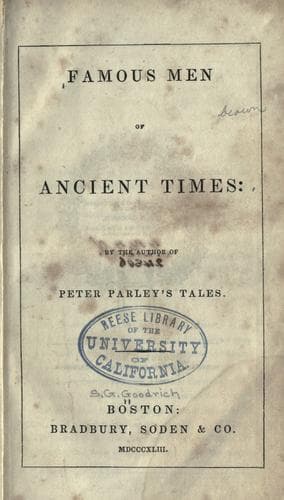
Famous Men of Ancient TimesGoodrich, Samuel G. (Samuel Griswold)
History
Famous Men of Ancient Times
Goodrich, Samuel G. (Samuel Griswold)
Biography -- Juvenile literature; Men -- Biography -- Juvenile literature
The case of Roscius was this. His father was killed in the recent
proscription of Sylla, and his estate, worth about £60,000 sterling,
was sold, among the confiscated estates of the proscribed, for a
trifling sum, to L. Cornelius Chrysogonus, a young favorite slave, whom
Sylla had made free, and who, to secure possession of it, accused the
son of the murder of his father, and had prepared evidence to convict
him; so that the young man was likely to be deprived, not only of his
fortunes, but, by a more villanous cruelty, of his honor also, and his
life.
The tyrant Sylla was at this time at the height of his power. Fearing
his resentment, therefore, as well as the influence of the prosecutor,
the older advocates of Rome refused to undertake the defence of
Roscius, particularly as it would lead them into an exposure of the
corruptions of the age, and the misdemeanors of those high in rank and
office.
But Cicero readily undertook it, as a glorious opportunity of enlisting
in the service of his country, and giving a public testimony of his
principles, and his zeal for that liberty to the support of which he
was willing to devote the labors of his life. In the management of the
cause, he displayed great skill and admirable eloquence. Roscius was
acquitted, and Cicero was applauded by the whole city for his courage
and address. From this period he was ranked as one of the ablest
advocates of Rome.
Having occasion in the course of his pleading to mention that
remarkable punishment which their ancestors had contrived for the
murder of a parent—that of sewing the criminal alive into a sack, and
throwing him into a river—he says, “that the meaning of it was, to
strike him at once, as it were, out of the system of nature, by taking
him from the air, the sun, the water, and the earth; that he who had
destroyed the author of his being, should lose the benefit of those
elements whence all things derive their being. They would not throw him
to the beasts, lest the contagion of such wickedness should make the
beasts themselves more furious; they would not commit him naked to the
stream, lest he should pollute the very sea, which was the purifier of
all other pollutions; they left him no share of anything natural, how
vile or common soever; for what is so common as breath to the living,
earth to the dead, the sea to those who float, the shore to those who
are cast up? Yet these wretches live so, as long as they can, as not to
draw breath from the air; die so, as not to touch the ground; are so
tossed by the waves, as not to be washed by them; so cast out upon the
shore, as to find no rest, even on the rocks.”
Public-domain text, read in full here on John Shaqi.
Reviews
Reviews
No reviews yet
Be the first to share your thoughts on this work.
Join the Discussion
Join the discussion
Sign in to leave a comment or review.
Sign InorCreate an account