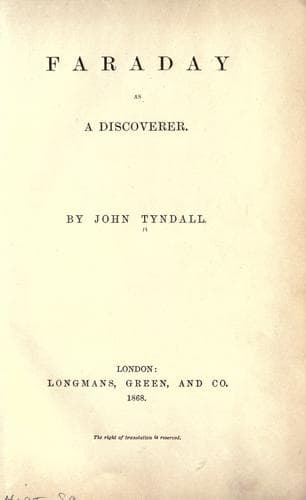
Faraday, Michael, 1791-1867; Physicists -- Great Britain -- Biography
At the end of his papers, when he takes a last look along the line of
research, and then turns his eyes to the future, utterances quite as
much emotional as scientific escape from Faraday. 'I cannot,' he says,
at the end of his first paper on magne-crystallic action, 'conclude
this series of researches without remarking how rapidly the knowledge of
molecular forces grows upon us, and how strikingly every investigation
tends to develop more and more their importance, and their extreme
attraction as an object of study. A few years ago magnetism was to us an
occult power, affecting only a few bodies, now it is found to influence
all bodies, and to possess the most intimate relations with electricity,
heat, chemical action, light, crystallization, and through it, with
the forces concerned in cohesion; and we may, in the present state of
things, well feel urged to continue in our labours, encouraged by the
hope of bringing it into a bond of union with gravity itself.'
Supplementary remarks
A brief space will, perhaps, be granted me here to state the further
progress of an investigation which interested Faraday so much. Drawn by
the fame of Bunsen as a teacher, in the year 1848 I became a student in
the University of Marburg, in Hesse Cassel. Bunsen's behaviour to me
was that of a brother as well as that of a teacher, and it was also my
happiness to make the acquaintance and gain the friendship of Professor
Knoblauch, so highly distinguished by his researches on Radiant Heat.
Plucker's and Faraday's investigations filled all minds at the time,
and towards the end of 1849, Professor Knoblauch and myself commenced
a joint investigation of the entire question. Long discipline was
necessary to give us due mastery over it. Employing a method proposed by
Dove, we examined the optical properties of our crystals ourselves;
and these optical observations went hand in hand with our magnetic
experiments. The number of these experiments was very great, but for
a considerable time no fact of importance was added to those already
published. At length, however, it was our fortune to meet with various
crystals whose deportment could not be brought under the laws of
magne-crystallic action enunciated by Plucker. We also discovered
instances which led us to suppose that the magne-crystallic force was
by no means independent, as alleged, of the magnetism or diamagnetism of
the mass of the crystal. Indeed, the more we worked at the subject, the
more clearly did it appear to us that the deportment of crystals in the
magnetic field was due, not to a force previously unknown, but to
the modification of the known forces of magnetism and diamagnetism by
crystalline aggregation.
Public-domain text, read in full here on John Shaqi.
Reviews
Reviews
No reviews yet
Be the first to share your thoughts on this work.
Join the Discussion
Join the discussion
Sign in to leave a comment or review.
Sign InorCreate an account