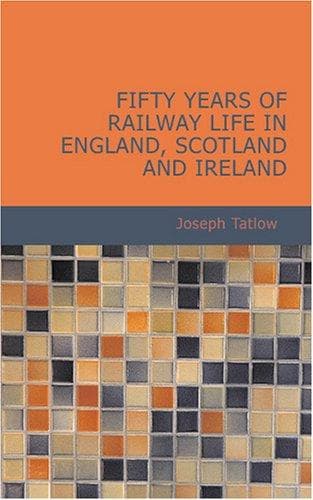
Fifty Years of Railway Life in England, Scotland and IrelandTatlow, Joseph
History
Fifty Years of Railway Life in England, Scotland and Ireland
Tatlow, Joseph
Railroads -- Great Britain -- History
CHAPTER XI.
THE RAILWAY JUBILEE, AND GLASGOW AND SOUTH-WESTERN OFFICERS AND CLERKS
The 27th day of September, 1875, was the Jubilee of the British Railway
System. It was celebrated by a banquet given by the North-Eastern
Railway Company at Darlington, for the Stockton and Darlington section of
the North-Eastern was, as I have mentioned before, the first public
railway. A thousand guests were invited. No building in Darlington
could accommodate such a number, and a great marquee, large enough to
dine a thousand people, was obtained from London. My chief attended the
banquet and I remained at home to hear the news when he returned. Dan
Godfrey's band was there, and Dan Godfrey himself composed some music for
the occasion. The _menu_ was long, elaborate and imposing; equalled only
by the _toast list_, which contained no less than sixteen separate
toasts. It was a Gargantuan feast befitting a great occasion. Could we
men of to-day have done it justice and sat it and the toast list out, I
wonder. It took place over forty years ago, when the endurance of the
race was, perhaps, greater than now; or why do we now shorten our
banquets and shirk the bottle?
The Stockton and Darlington Railway is 54 miles long, and its authorised
capital was 102,000 pounds--a modest sum indeed, under 2,000 pounds per
mile, less than half the outlay for land alone of the North Midland line
and not one twenty-fifth of the average cost of British railways as they
stand to-day, which is some 57,000 pounds per mile. The railway owed its
origin to George Stephenson and to Edward Pease, the wealthy Quaker and
manufacturer of Darlington, both burly men, strong in mind as body. The
first rail was laid, with much ceremony, near the town of Stockton, on
the 23rd of May, 1822, amid great opposition culminating in acts of
personal violence, for the early railways, from interests that feared
their rivalry, and often from sheer blind ignorance itself, had bitter
antagonism to contend with.
The day brought an immense concourse of people to Darlington, all bent on
seeing the novel spectacle of a train of carriages and wagons filled with
passengers and goods, drawn along a _railway_ by a _steam_ engine. At
eight o'clock in the morning the train started with its load--22
vehicles--hauled by Stephenson's "Locomotion," driven by Stephenson
himself. "Such was its velocity that in some parts of the journey the
speed was frequently 12 miles an hour." The number of passengers reached
450, and the goods and merchandise amounted to 90 tons--a great
accomplishment, and George Stephenson and Edward Pease were proud men
that day.
Seven years from this present time will witness the _Centenary_ of the
railway system. How shall we celebrate _it_? Will railway proprietor,
railway director and railway manager on that occasion be animated with
the gladness, the pride and the hope that brightened the Jubilee Banquet?
Who can tell? The future of railways is all uncertain.
Public-domain text, read in full here on John Shaqi.
Reviews
Reviews
No reviews yet
Be the first to share your thoughts on this work.
Join the Discussion
Join the discussion
Sign in to leave a comment or review.
Sign InorCreate an account